

Stocks had an exciting week as we went from everything bubble to everything crash in about a day and a half.
With gold and silver loving every minute.
The Japan Crash
In case you just woke up, stocks crashed on Tuesday -- Monday was a holiday -- losing 870 points on the Dow.
Mainstream media blamed Trump’s tariff threat over Greenland. But thanks to Bitcoin -- which trades 24/7 -- we can actually go to the tape.
Turns out Greenland barely made a dent, what caused the bloodbath was Japan.
Specifically, Japan’s new Prime Minister Takaichi called a snap election to beef up her party’s seat count ahead of a raft of reforms to slash taxes and hike government spending.

This sent Japanese bond rates soaring as bond investors panic that maybe the government can’t pay its debt.
Making it a near-perfect replay of the British bond crisis back in 2022.
The problem for US markets is that -- unlike Britain -- Japan has something called the carry trade.
Where hundreds of trillions of yen stand borrowed by overseas hedge funds and speculators in a free lunch funded by the Bank of Japan -- their Fed.
Soaring Japanese bond yields crush this trade, which can set off a global rush for the exits.
How Japan Went Bad
Japan’s original sin is when their easy money bubble burst in 1990, instead of letting weak companies and banks die off they put them on permanent life support with stimulus and low interest rates.
This created a zombie economy of money-losing companies that hog up a third of all bank lending and almost 10 million Japanese workers essentially paid to lose money.
The result is while American productivity grew by half since 1990 Japan’s actually dropped by a quarter.
Translating into real wages that are lower in Japan than 1990.

The crawling economy pushed govt to spend even more on stimulus — bread to go with the corporate bailout circus.
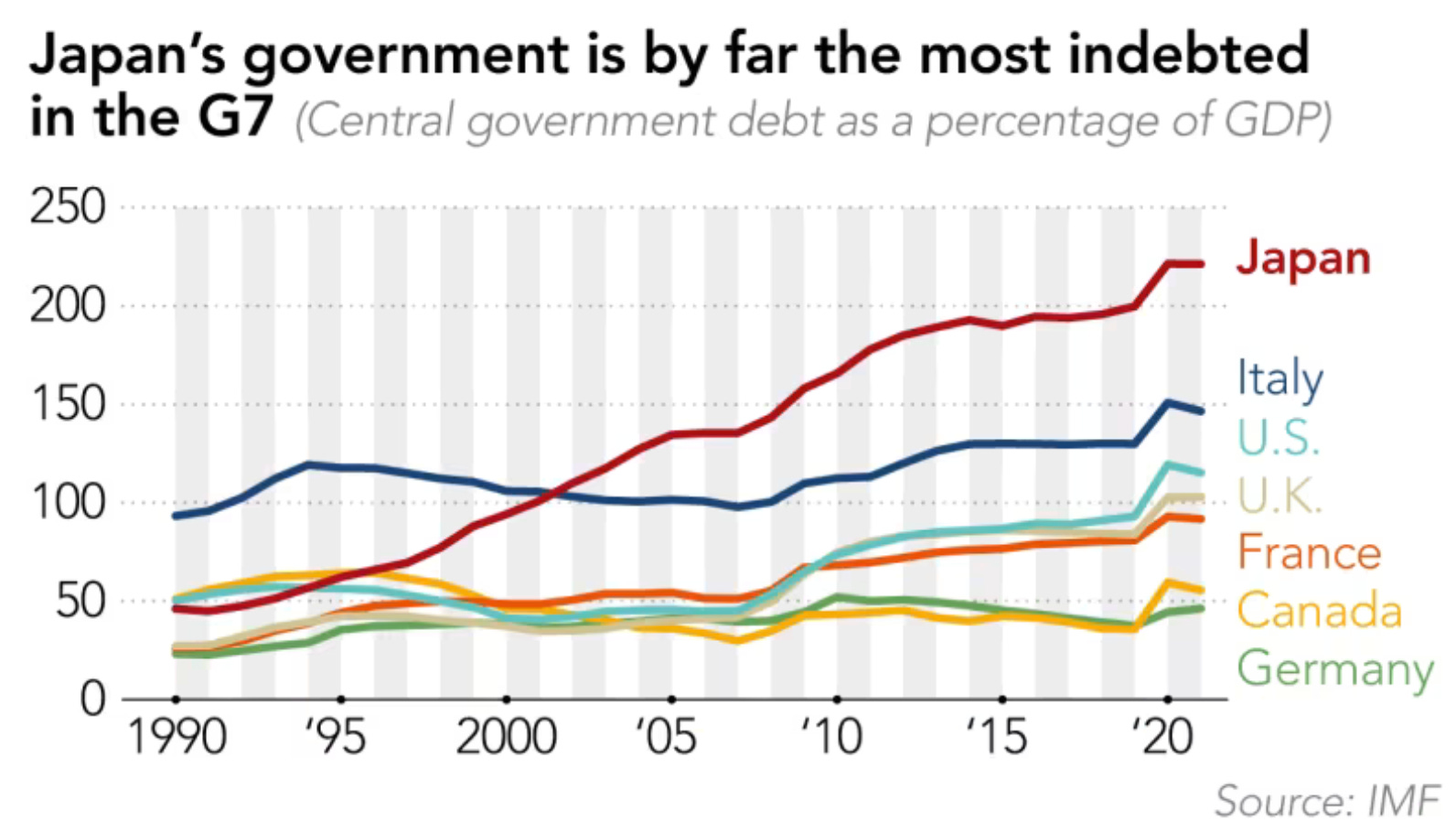
This drove debt to 230% of GDP — $70 trillion in US GDP terms.
Deutsche Bank’s head of currency research George Saravelos actually pegs Japanese debt at twice that once you include government-linked pensions, the Bank of Japan, and state-owned banks.
So that’s $140 trillion in US GDP terms. Which is just shy of a bazillion.
Now, to finance all that debt Japan’s central bank pushed interest rates near zero for roundabout 30 years. Which you have to do because otherwise the debt interest eats you alive.
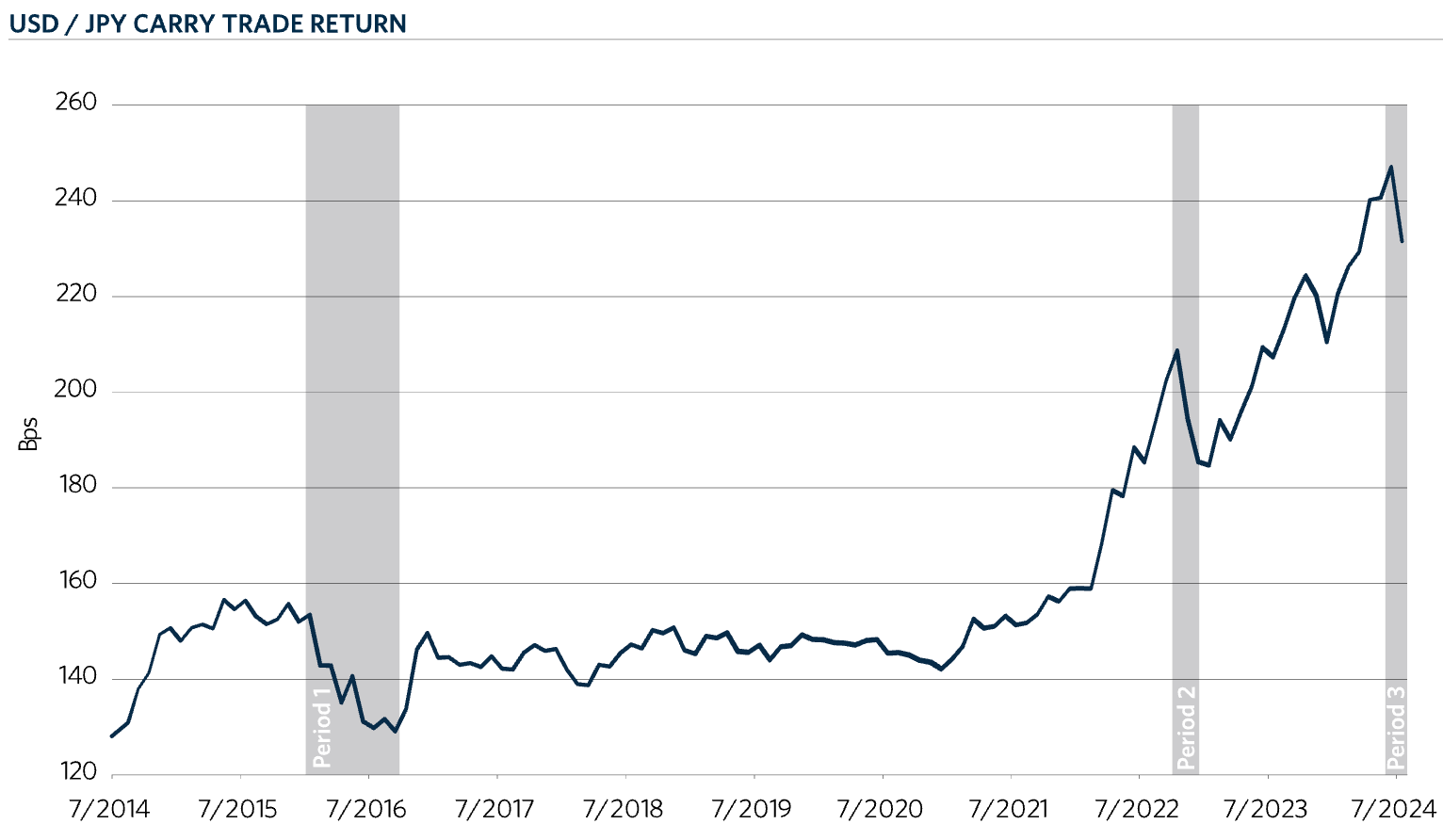
But this created the free money machine of the century, the yen carry trade. Where overseas hedge funds and speculators borrow yen at zero and put the money into US asset paying 5% -- bonds -- or 8% -- stocks.
So borrow at 0, invest at 5 to 8.
The Carry Trade: Fentanyl of Finance
Thing is the carry trade works only if Japan’s rates stay low and the yen stays weak.
Because the low rates are the juice. But if the yen gets strong the debt outgrows the dollar investment.
The problem is Takaichi’s presser sent Japanese bond yields soaring to over 4% on the 40-year -- almost matching US rates on the 30-year.
This took nearly all the profit out of the carry. Which kicked off a big unwind.
The problem is unwinding makes the yen stronger, since they dump the assets for dollars, then sell the dollars for yen to pay off the original loan.
You’re dumping dollars and buying yen.
That sent the yen soaring by half a percent in a matter of hours. Raising the prospect of a zero-profit carry swamped by a rising yen.
Suddenly the free money machine goes in reverse. You get a rush for the exits, 870 on the Dow in a single day.
What’s Next
Beyond the carry trade, Japanese bonds create an even bigger risk because they blow a hole in the Japanese banks and pensions whose vaults are full of Japanese government debt.
That happened in America two years ago, when Fed hikes crashed a parade of banks starting with Silicon Valley Bank.
If that happens in Japan, institutions will pile on top of the carries to dump overseas assets -- which are overwhelmingly American assets.
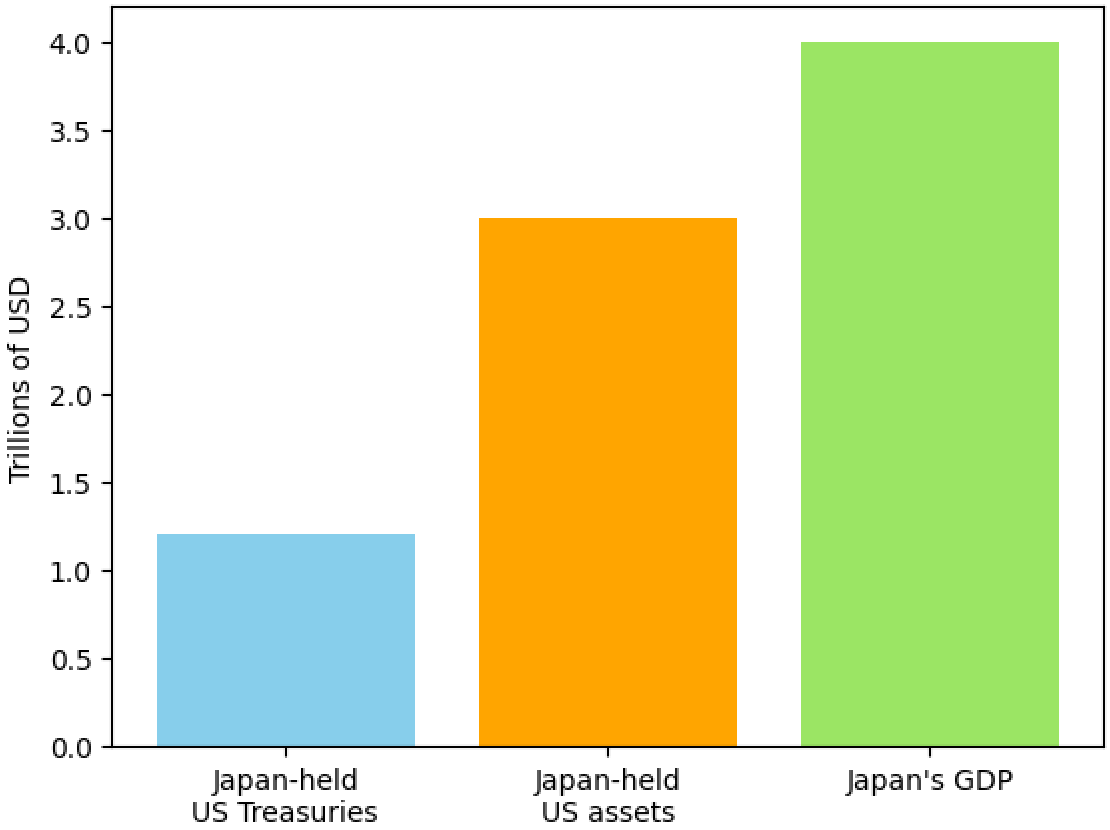
Japan is the single biggest holder of US federal debt with $1.2 trillion. Toss in banks and pensions and and they hold over $3 trillion in American assets ranging from stocks to corporate bonds to US treasuries.
40 years of economic mismanagement brought Japan to the edge of Argentina. The blow-back will keep going until they put the zombie out of its misery.
Each week I write on Economics and Freedom. Consider joining over 22,000 subscribers and becoming a free or paid subscriber to support my work.
I also make 3.5-minute daily videos on economics and freedom:
20 minute Roundup Podcast of all the week’s videos: Search Peter St Onge on all major podcast platforms.
Is the entire world getting to the point that paper money is just turning in to funny money? The debt and deficits are insane.
The federal debt is a time bomb & a day of reckoning is coming . Too many hogs at the trough ! Running out of feed .