


First, investment returns on the month.
As of this morning, September 30, my watch-list of winners gained 12% on the month — a zany 290% annualized. The losers to short are down an even crazier 17.8% on the month, which is a similarly happy minus 90% annualized.
All this juicy goodness on a month the benchmark SPY (S&P 500) was essentially flat.
That brings the “Adrenaline” growth portfolio to a monthly return of 7.8%, while the “Market Neutral” portfolio is actually up 9.8% on the month since the losers did so bad.
Bringing year-to-date 2026 gains to 36.5% on Adrenaline, a nearly identical 36.8% on Market Neutral. Annualized, both are about 51% — triple the S&P.
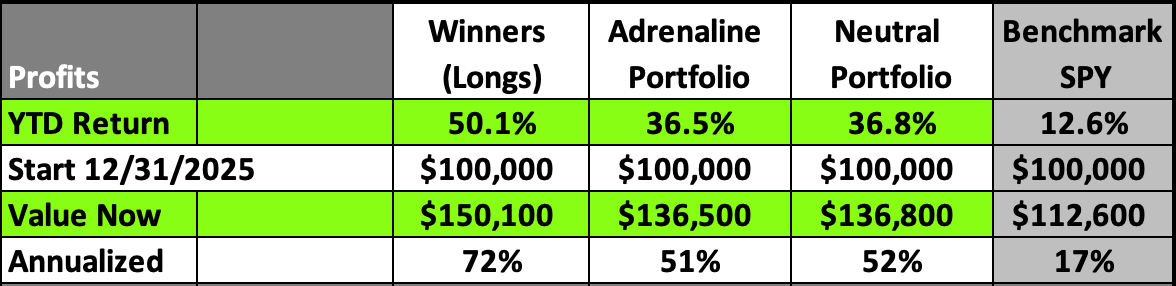
Details on the portfolios are below — alas after the paywall.
On to the economy, recession odds are plunging, America is still growing, still hiring, and still spending. So much for AI eating all the jobs and gutting profits in everything else. And so much for the dozen depressions left-wing media predicted under Trump.
But we’re paying for it in inflation, interest costs, and a bond market that’s starting to panic since Congress is spending like drunk sailors who stumbled across 2 and a half trillion dollars.
Going to the tape, second-quarter GDP came in at a tame 1.5% annualized. But real private domestic demand -- consumer spending plus investment, so pretty much the whole show -- was a solid 4.2%. And corporate profits soared by $400 billion in the quarter, a blistering 42% annualized.
In short, this is not a recession even with oil flirting with $100 depending on the week.
Jobs confirmed it: After months of fears of a “no hire, no fire” economy when AI eats all the jobs, August added 162,000 payroll jobs, with unemployment steady at a comfortable 4.1%. The hiring was not spectacular, but it’s solid considering the war and a tight Fed.
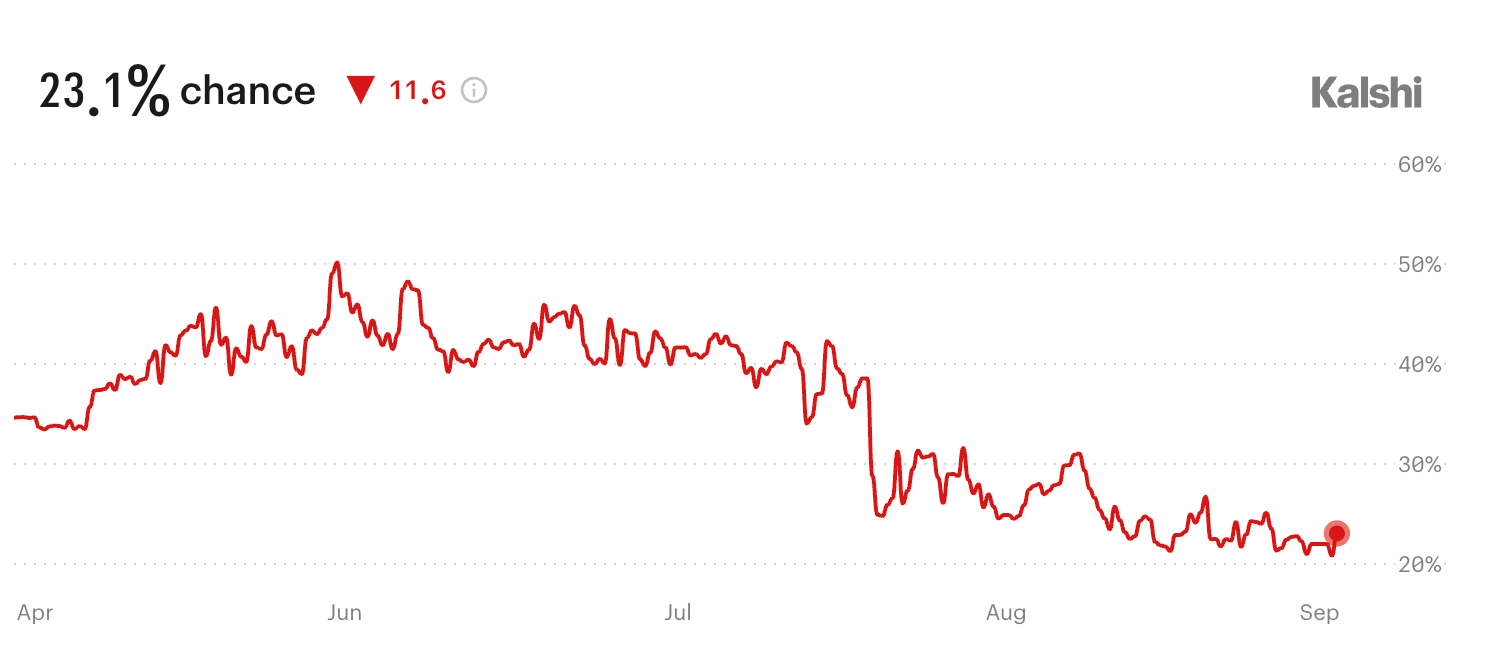
None of this is recession territory. In fact, prediction market Kalshi now pegs just 23% odds of a recession by the end of 2027 -- down from nearly half in June.
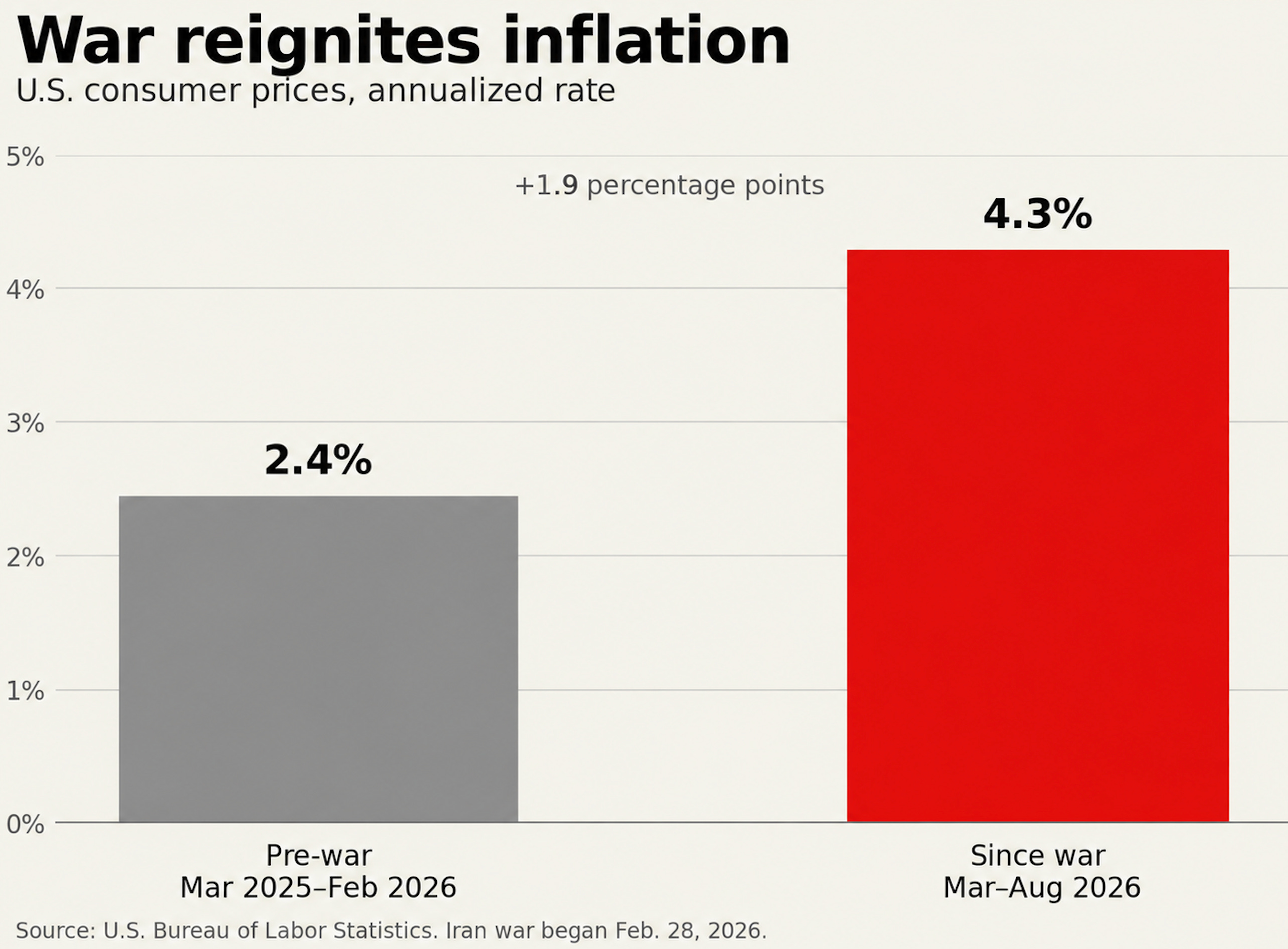
The catch is inflation, and bond markets that are downstream of it. CPI jumped 0.4% in August -- annualized 5%. Which raised headline inflation to 3.4% year over year.
That’s nearly double the Fed’s target of 2%, which it’s failed to achieve going on five and a half years of “transitory” inflation.
A lot of that is Hormuz-driven energy prices. But even core inflation -- which strips out food and energy -- rose 4% annualized on the month. So even beyond gasoline’s jump of 27% over the year, broad inflation is not dead.
The reason, of course, is Washington keeps pumping out $2.5 trillion deficits. Which going by history will jump to $4 trillion when that recession recession does hit — World War 2 fiscal territory.
And that takes us to the Fed, which resumed hikes last month for the first time in three years. This took us to 4% target Fed Funds Rate.
That’s a lot better than 5.5% a couple years ago, but it compares to just 0.25% during Covid, when the Fed was running the money printers on max to bribe voters into lockdowns.
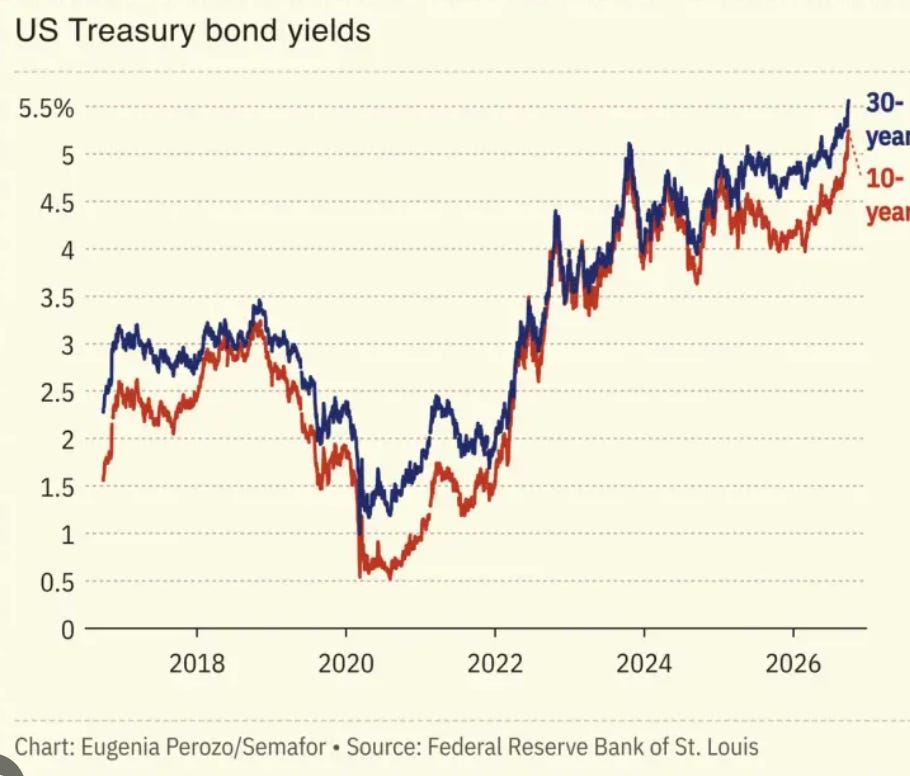
More than the Fed, the big story this month was the bond market. The 10-year and 30-year Treasury yields are the two to watch. The 10-year is designed to look past the boom-bust cycle -- 10 years bridges a typical cycle. So it’s a market read on long-run inflation, growth, and fiscal credibility. While the 30-year is the longer-duration warning light that, of course, tracks mortgages.
Both leapt this month, hitting the highest levels in nearly 25 years. This is ominous because it means markets are worrying whether the federal government can finance -- and repay -- its exploding $40 trillion of debt.
Because if governments are borrowing too fast -- like, say, 7% of GDP as we’re doing now, which is 5x growth -- then bond investors start to worry they won’t get their money back. They demand a higher rate.
The fear isn’t that Washington will literally stop payment. But they can put a finger on the inflation scale to melt away the debt. The illustrative case is Weimar Germany, which didn’t default, it simply printed money to the point the national debt was worth less than a loaf of bread.
Near-term, rising bond yields pushes up every other rate in the economy — corporate borrowing, commercial real estate, car loans, mortgages.
Long-term, it could set off a doom-loop where higher rates push up Washington’s interest expense -- already more than a trillion a year -- that leads to bigger deficits, bigger interest costs, rinse and repeat bigger and bigger.
Now, there’s an entire industry that’s been predicting a bond market collapse ever since Nixon ended the gold standard. I don’t think it’s happening tomorrow -- bond auctions are clearing, while 5% yields aren’t necessarily dangerous. In the go-go 90’s they were closer to 7%.
But the direction matters: more debt supply, more inflation risk, and fewer buyers willing to subsidize Washington means structurally higher rates for decades. While $40 trillion of debt means 7% would hurt a lot more today than in the 90’s or the 70’s.
Moving to stocks, despite the bond drama, stocks are still humming -- driven by that 40% annualized jump in profits. The S&P 500’s up double-digits this year -- despite the war. Nasdaq’s closer to 20%, powered by AI.
It may not feel like it, but market volatility (VIX) is actually low, surprisingly given ongoing drama in both the trade war and the shooting war.
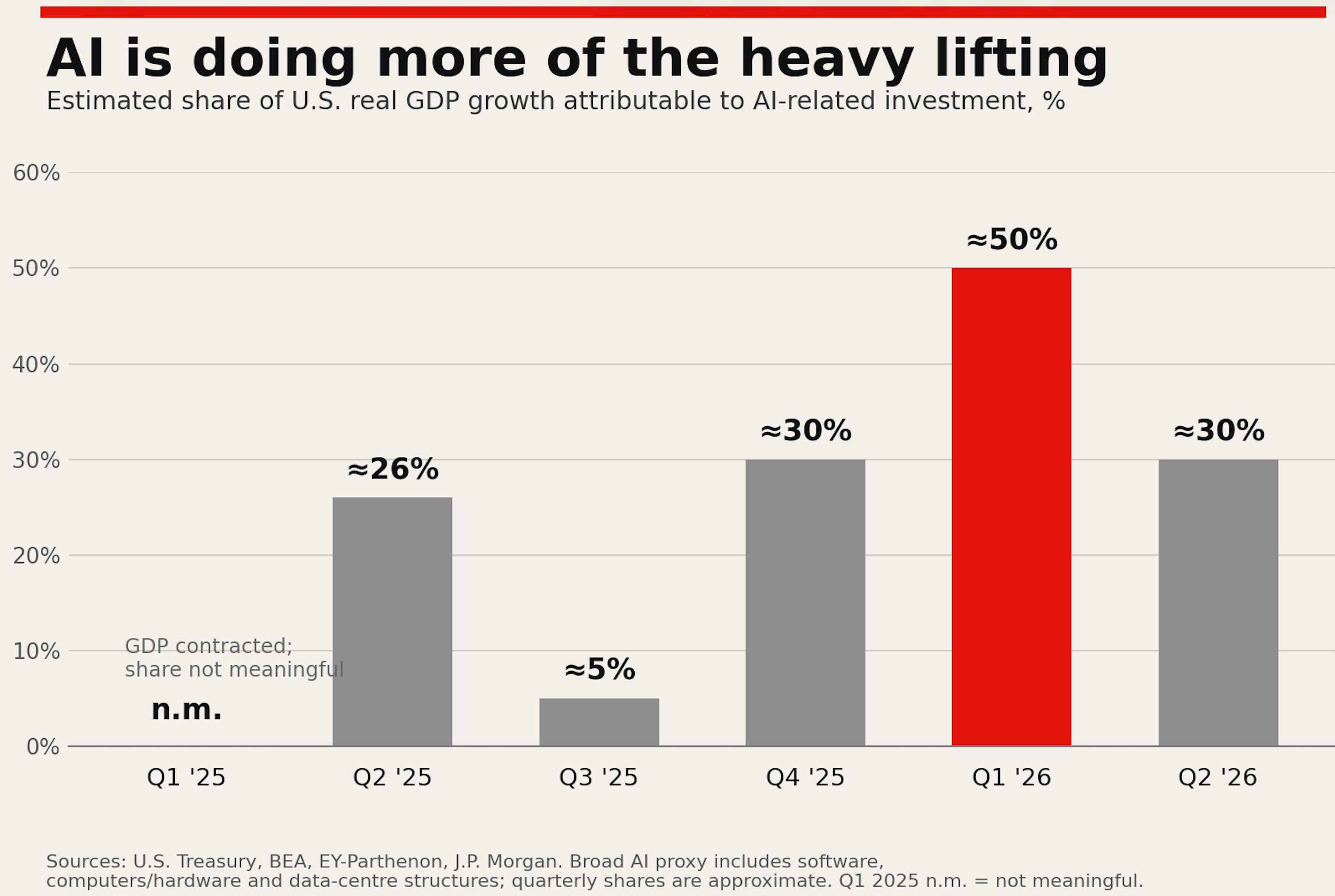
The wild card is US growth is increasingly depending on AI investment, which is now more than half of annual growth and is by far the biggest capital-spending boom in history.
If AI regulation gets traction, or if upcoming mega-IPO’s of OpenAI and Anthropic get derailed, or if defaults spread on the trillions of data center spend, AI is big enough to pull the entire economy into recession.
Putting it together, the economy is stronger than the doomers say. Inflation is stickier than the optimists say. And the bond market is taking Washington’s debts out of households and job growth.
With that, let’s talk specific stocks to park your stash. Strategically, I use Austrian economics to figure out where we are in the business cycle, then allocate capital into companies that are likely to benefit, while shorting companies that look over-valued.
If you’re not subscribed, it’s 8 bucks a month to cover the time it takes, and your subscription includes the weekly articles and access to all archives — more than 80 articles and growing.
Let’s dig in.