


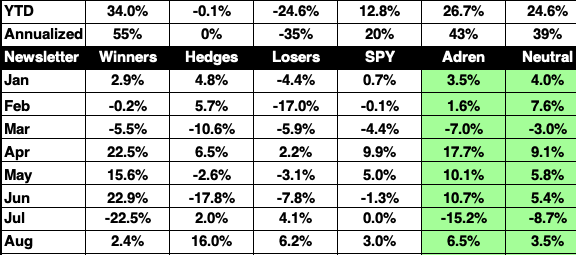
After last month’s 22.5% AI bear market, my semiconductor picks recovered 2.4% in August. That brings the winners to 34.0% year-to-date — 55% annualized.
The AI-disruption shorts went the wrong way, rising 6.2%. Still, their year-to-date profits stand at 24.6%, or 39% annualized.
But this month inflation hedges stole the show: Bitcoin rose 23.3%, silver 14.6%, and gold 10.1%, for a basket average of 16.0%.
Together, the Adrenaline portfolio is up 26.7% year-to-date and the Market Neutral portfolio is up 24.6%, compared with 12.8% for the S&P 500.
In dollar terms, $100,000 invested at New Year is tracking at $126,700 in Adrenaline, $124,600 in Market Neutral, and $112,800 in SPY.

Where the Economy Stands
Second-quarter GDP grew at just 1.5% annualized, down from 2.1% in the first quarter. That is remarkably weak considering federal deficits are running at 11.1% of GDP—nearly three times the 3.8% average since Nixon closed the gold window in 1971.
In other words, Washington is borrowing at emergency levels to produce growth that rounds down to stagnation.
Jobs sent an even stronger warning. Employers cut 23,000 payrolls in July, yet unemployment somehow improved to 4.1%.
Part of the paradox is that payrolls and unemployment come from separate surveys. One counts jobs; the other counts people. But the bigger explanation is that 2.5 million Americans have left the labor force since November.
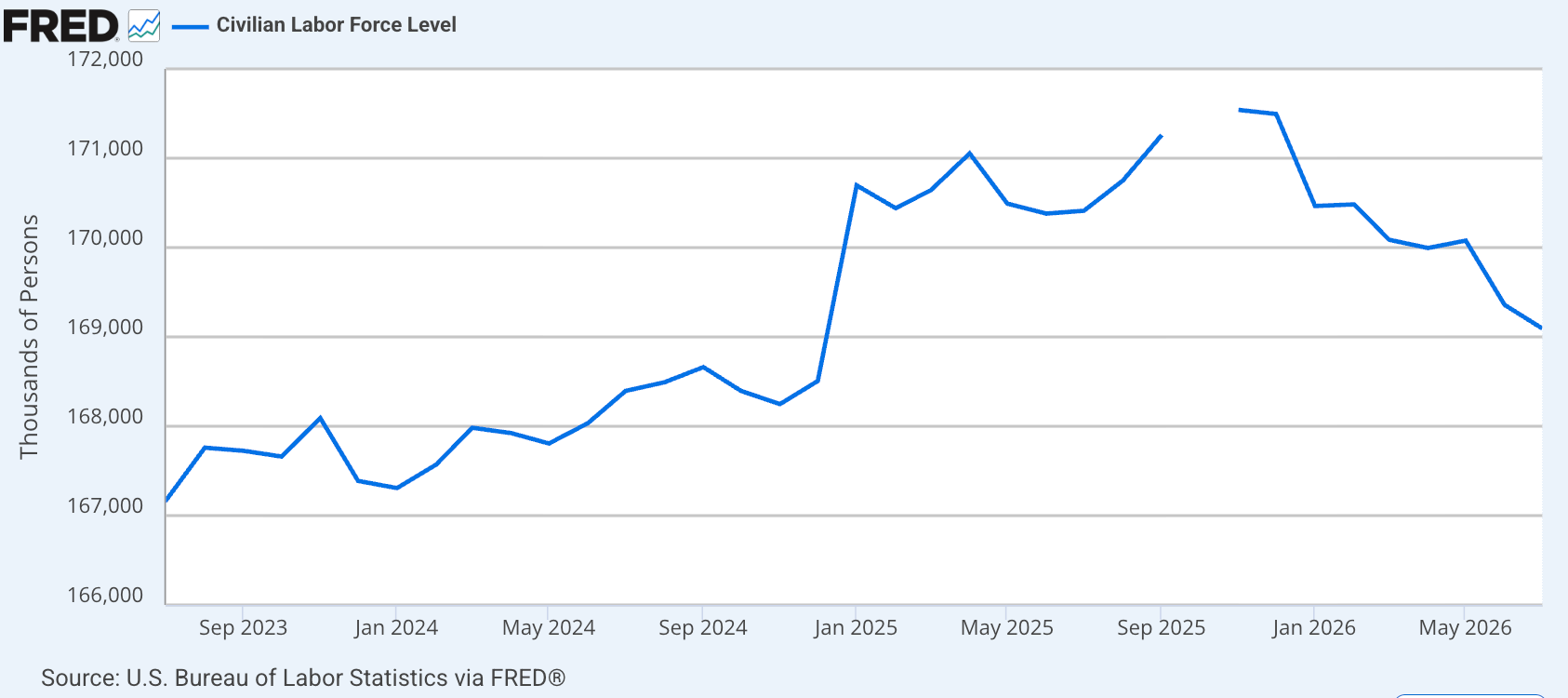
Roughly half may reflect retiring Baby Boomers and statistical noise. Perhaps one-fifth comes from lower immigration. That leaves roughly one-third unexplained—and disproportionately concentrated among Americans aged 55 to 64.
They could be discouraged workers, people suffering chronic illness, people shifting onto government benefits, or affluent early retirees. The average household headed by somebody aged 55 to 64 holds around $1.57 million in wealth, enough to generate $94,000 per year at a 6% return.
All four groups disappear from unemployment when they stop looking. So a 4.1% unemployment rate does not necessarily mean Americans found jobs. It may mean they stopped searching.
Inflation is equally muddy. Year-over-year inflation is around 3.5%, but much of the increase reflects wartime energy prices. Before the Iran war, monthly inflation was nearly flat, while some private measures were below 1%.
The Fed must decide whether to fight today’s energy shock or assume it fades. So both halves of its mandate are malfunctioning: jobs fell while unemployment improved, and inflation rose while underlying domestic price pressure cooled.
Jackson Hole Meets the $40 Trillion Debt Bomb
That made Kevin Warsh’s first Jackson Hole address the month’s main event.
Markets hoped Warsh would validate rate cuts. Instead, he said inflation remains above the Fed’s 2% target, financial conditions remain loose, and the central bank still has “work to do.”
Traders pushed the probability of a September hike from roughly 35% before the speech to 56% afterward. The two-year Treasury yield jumped nearly 12 basis points to 4.35%, its biggest one-day post-Jackson Hole increase since 1996. The ten-year rose to 4.72%.
More important, Warsh said forward guidance has “outstayed its welcome.” That could end the post-2008 regime where the Fed became Wall Street’s portfolio manager, telegraphing cheap money so large institutions could pump stocks, real estate, leveraged buyouts, and financial engineering.
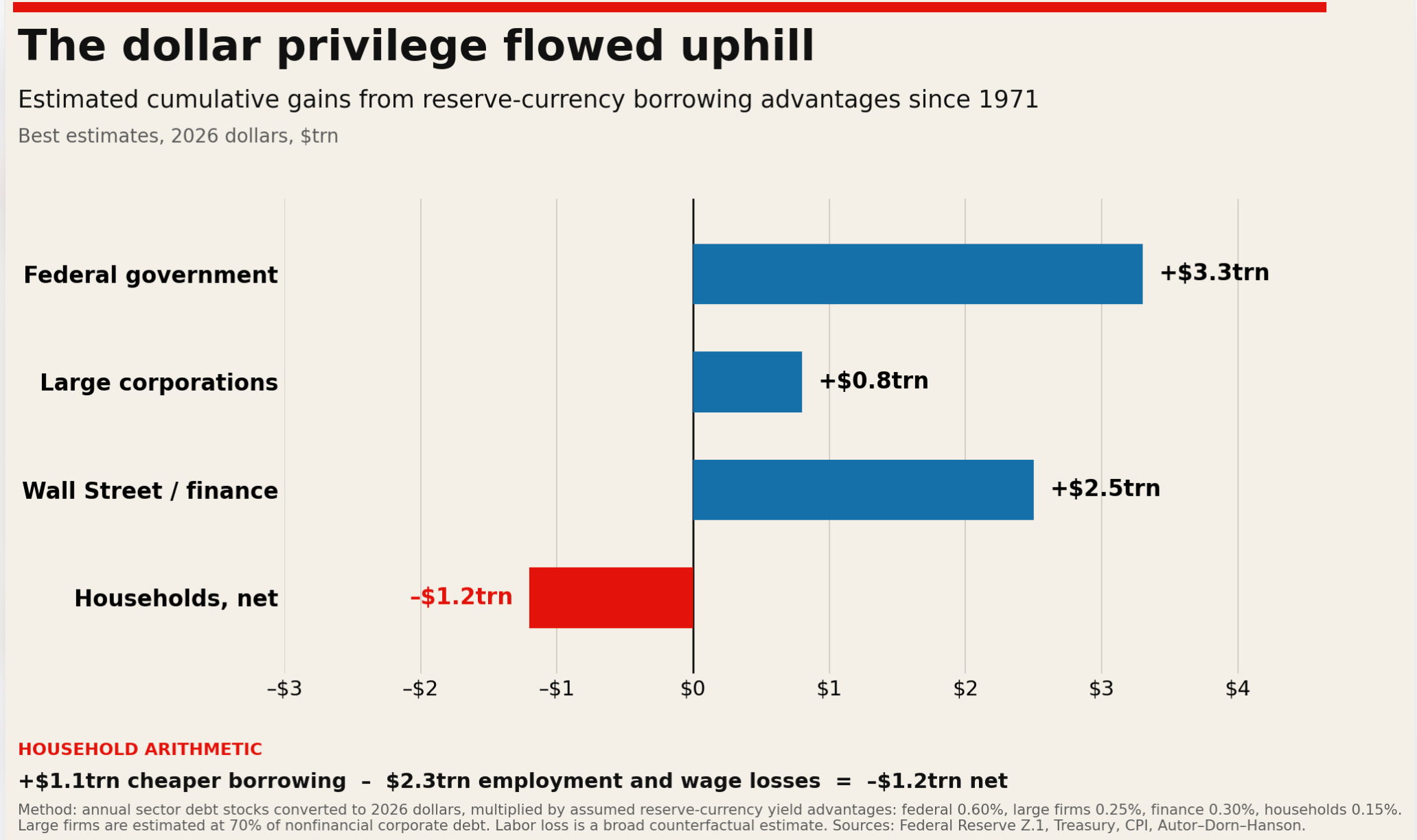
The Fed–Wall Street machine also squandered America’s reserve-currency privilege. Global demand for dollars should have been a national windfall. Instead, Washington, Wall Street, and the Fed siphoned it into bailouts, asset inflation, and government consumption.
Regular Americans never got the windfall. Instead, they got an overpriced currency that hollowed out manufacturing.
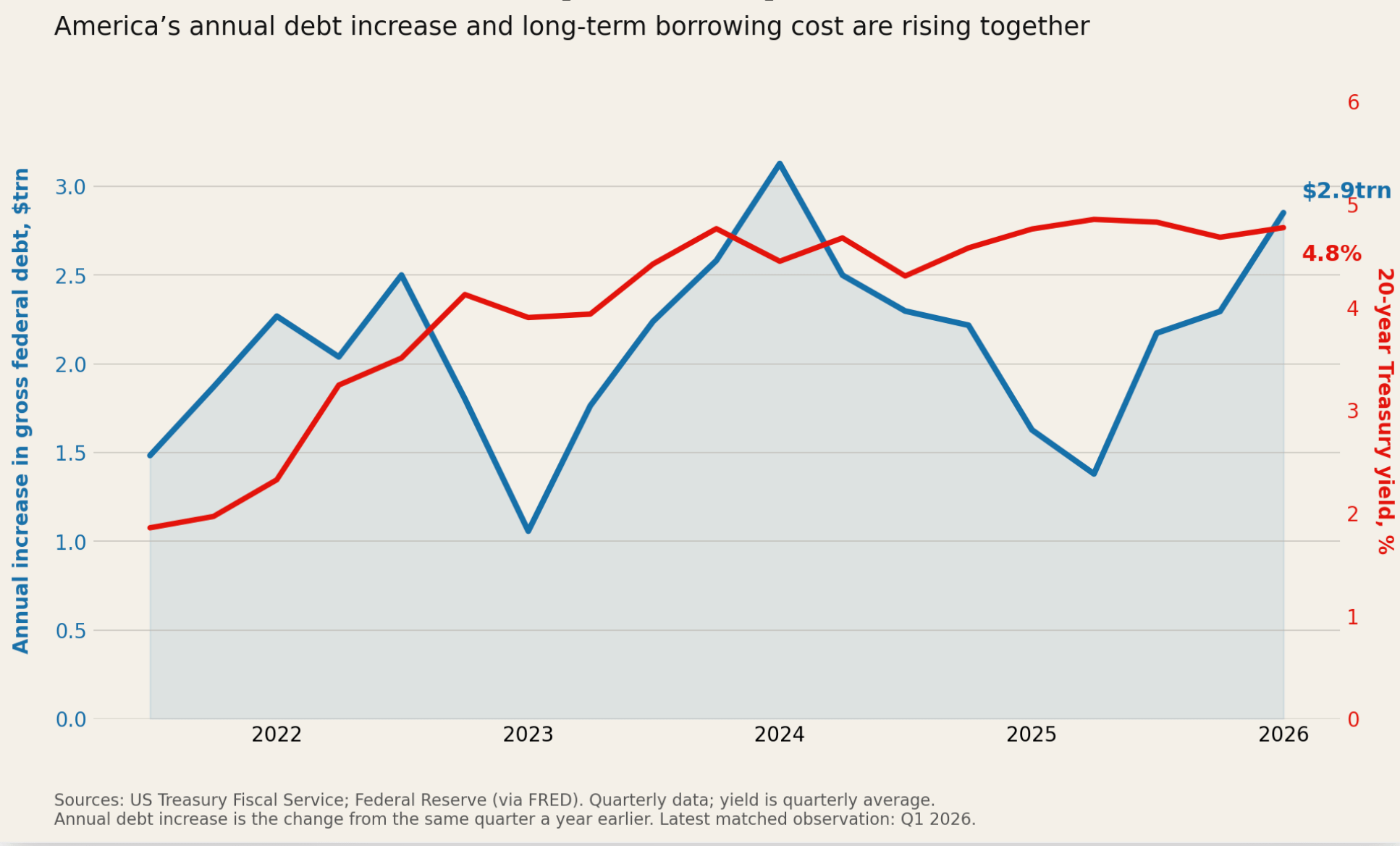
The other big news this month was the national debt crossing $40 trillion, up $2.4 trillion in less than eight months. And it’s driven by transfers — welfare, benefits, and pensions — that not only make up nearly half of all spending, but cannot politically be cut going by last year’s Battle Royale over SNAP fraud.
Interest expense along is approaching $1 trillion per year, on its way to $2.1 trillion by 2036 according to the CBO — and that’s assuming no recession, war, bailout, or new emergency.
Higher yields increase interest costs, which hit companies and consumers, but also increase the debt. That is the architecture of a fiscal doom loop. And the bond vigilantes finally noticed, bidding up interest rates on the national debt on fears they’ll either pump inflation to melt the debt or, if it comes to it, just default like several states did in 2008.
Markets Review
On to the money. Broad stocks survived the bond turmoil, with the S&P 500 reaching a 12.8% year-to-date gain—roughly 20% annualized. But with the ten-year Treasury paying about 4.7%, every S&P 500 sector now offers a dividend yield below government bonds. Stocks finally have competition.
AI infrastructure recovered unevenly from last month’s crash, while AI-disruption tempered some of their misery all year.
But hedges were the month’s clear winner. Bitcoin gained 23.3%, silver rose 14.6%, and gold added 10.1%. Driven by investors confronted $40 trillion of debt, trillion-dollar interest costs, wartime inflation, and the possibility that the Fed will continue debasing rather than force Congress to cut spending.
With that, updates on portfolio holdings, performance, and what’s next — especially for AI stocks. If you’re not subscribed, it’s 8 bucks a month to cover the time it takes, and your subscription includes the weekly articles and access to all archives — more than 80 articles and growing.