


It’s official: the federal government is bankrupt.
You probably knew this. But Treasury admitting it is comforting. Or perhaps terrifying.
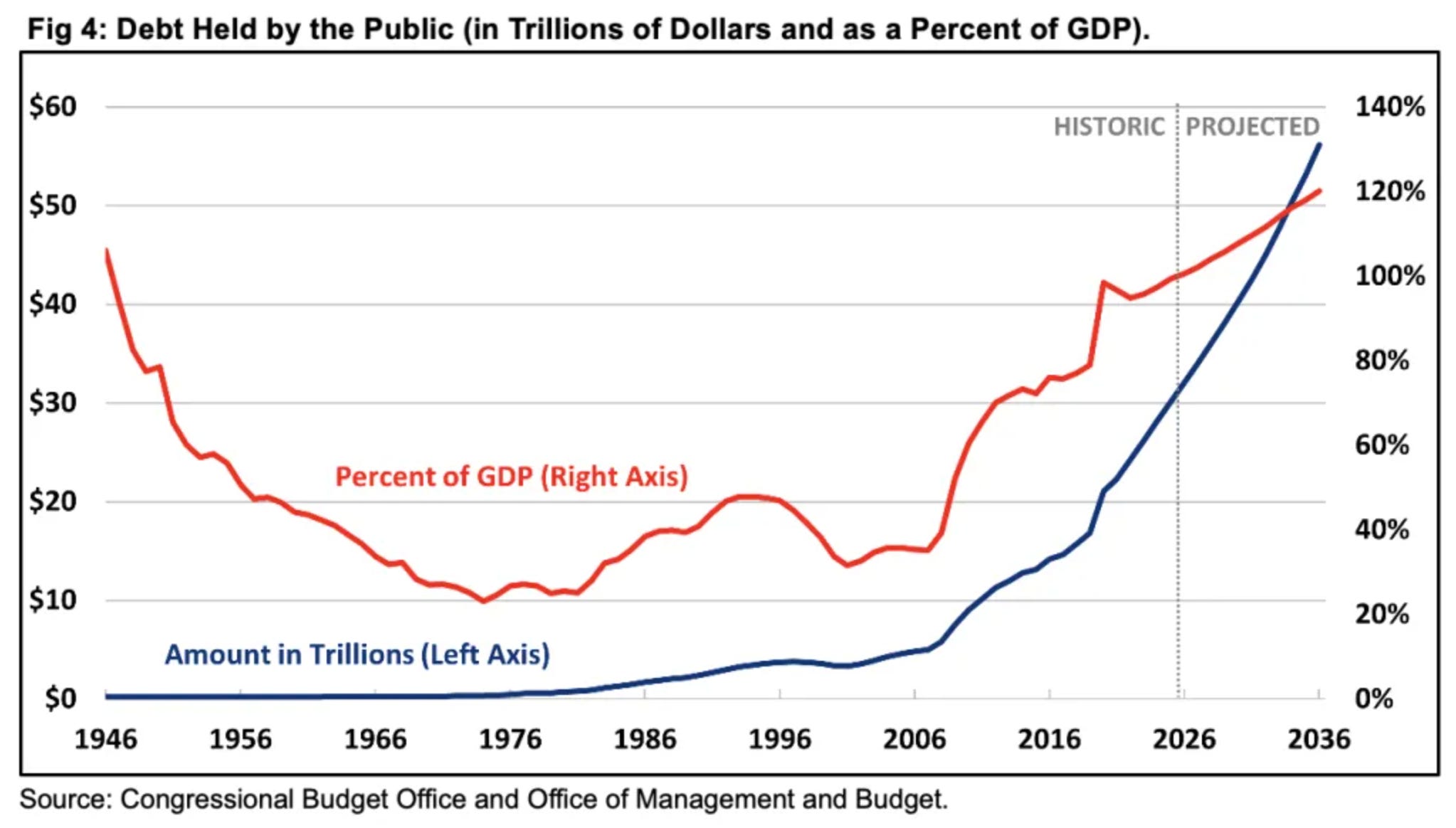
Last week the Department of Treasury released it consolidated financial statements for fiscal 2025, reporting that the federal government has just over $6 trillion in assets -- land, buildings, student loans. But, according to Treasury, it has nearly $48 trillion of debt.
That comes to negative $42 trillion. Which is roughly half a million dollars for a family of 4.

Worse, it’s deteriorating at $2.5 trillion per year — about $3,000 per month for that family of 4.
You’ll notice $48 trillion of debt is more than the official national debt, which just crossed $39 trillion 2 weeks ago.
That’s because of trillions of so-called non-debt liabilities like federal employee pensions and loan guarantees where government guarantees crony loans since it looks better than writing checks.
And keep in mind this is just the debt they know about. For the 29th year in a row the federal government auditor -- the GAO — stuck a big disclaimer saying this is only what they could find.
So there could be a lot more -- nobody knows. Certainly not the department that’s supposed to know.
Off-Balance Sheet Debt
It gets much worse. Because Treasury’s tally excludes $88 trillion in so-called off-balance sheet debt.
This is made up of even more pensions the government has guaranteed — like railroad workers. Along with Social Security and Medicare the government has promised to pay -- and will pay, given these are politically untouchable.

This $88 trillion of off-balance sheet debt rose by nearly $10 trillion last year with ongoing Social Security and Medicare shortfalls.
$10 trillion comes to an almost comical $12,000 per month for that beat-down family of 4.
Put it together and it’s at least $136 trillion dollars of debt, rising$ 12.5 trillion last year.
Put differently, one third of everything you made last year went to taxes.
Another third was earmarked for future government spending.
You live on the crumbs.

Converting all this into a typical American family, they make 80,000 a year — about $7,000 per month.
They carry between $150,000 and $200,000 of regular debt -- mortgage, cars, credit card.
And they owe $1.5 million of government debt -- rising at $12,000 per month. And that’s just the debt Treasury knows about.
Spot the problem.

What’s Next
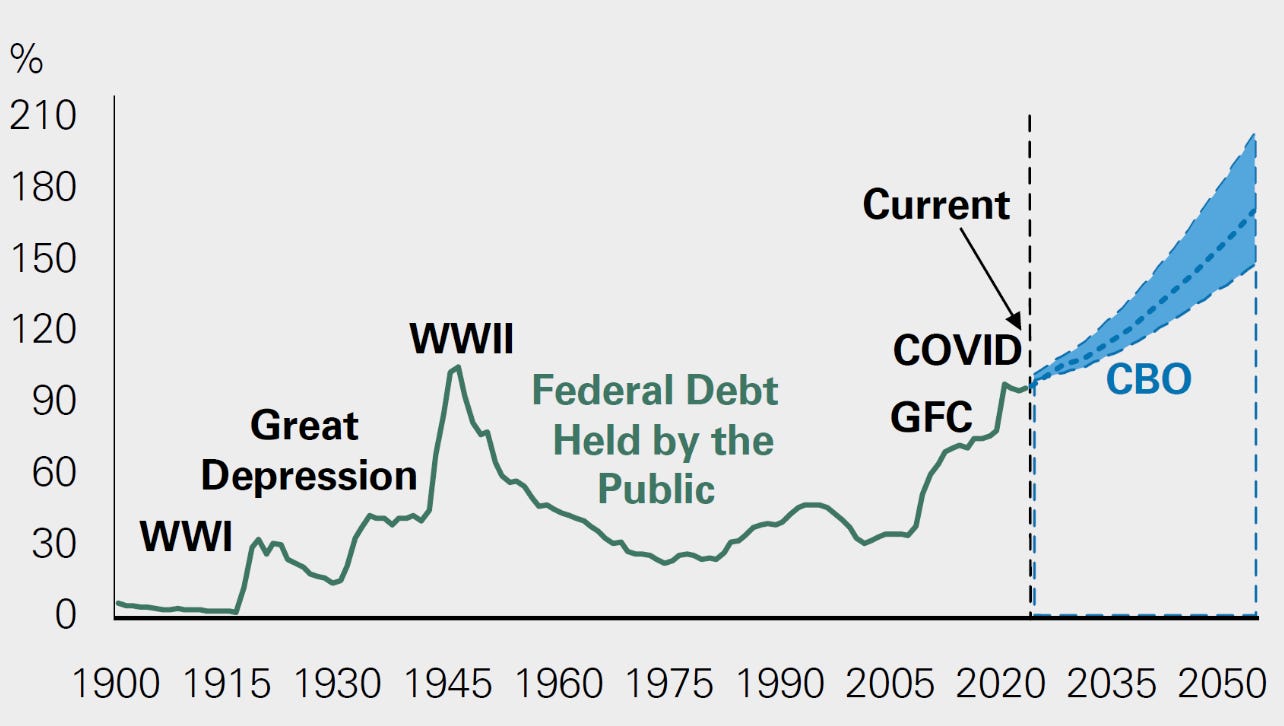
The war’s hogging the headlines at the moment. But behind the scenes we are headed off a fiscal cliff.
They’ll borrow as much as they can -- apparently $48 trillion so far -- to postpone the crash. To postpone that day when lenders stop, market interest rates spike, and we get a financial crisis that makes 2008 look like a picnic.
The solution’s easy: Slash federal spending by a couple trillion. Maybe hold off on new land wars for a couple decades. Close some Somali Leering Centers.
Even — dare we dream — a balanced budget amendment. Or my personal favorite, Warren Buffet’s proposal that if Congress can’t pass a balanced budget they have to resign and are banned from politics for life.
None of those will happen.
Because for both parties kicking the can is a lot more fun than slashing Washington.
Every week I write on Economics and Freedom. Consider joining over 23,000 subscribers and becoming a subscriber to support my work.
I also make daily 3-minute videos on economics and freedom, and every week I gather these into a 20 minute Roundup Podcast that posts on Spotify, Apple, and Google podcasts.
Sounds like a ponzi to me.....
BUT, Peter, why are you then promoting the bitcon and residency ruse...?
So because you can´t trust the Gubermint, you should trust some dude lawyer in the Caymans ?