


The national debt just crossed $40 trillion.
Congratulations, Congress -- you stole every penny.
That’s up nearly $2.4 trillion in less than eight months. It’s also roughly double the debt America carried just nine years ago.
What’s driving it? Simple: The welfare state is eating America.
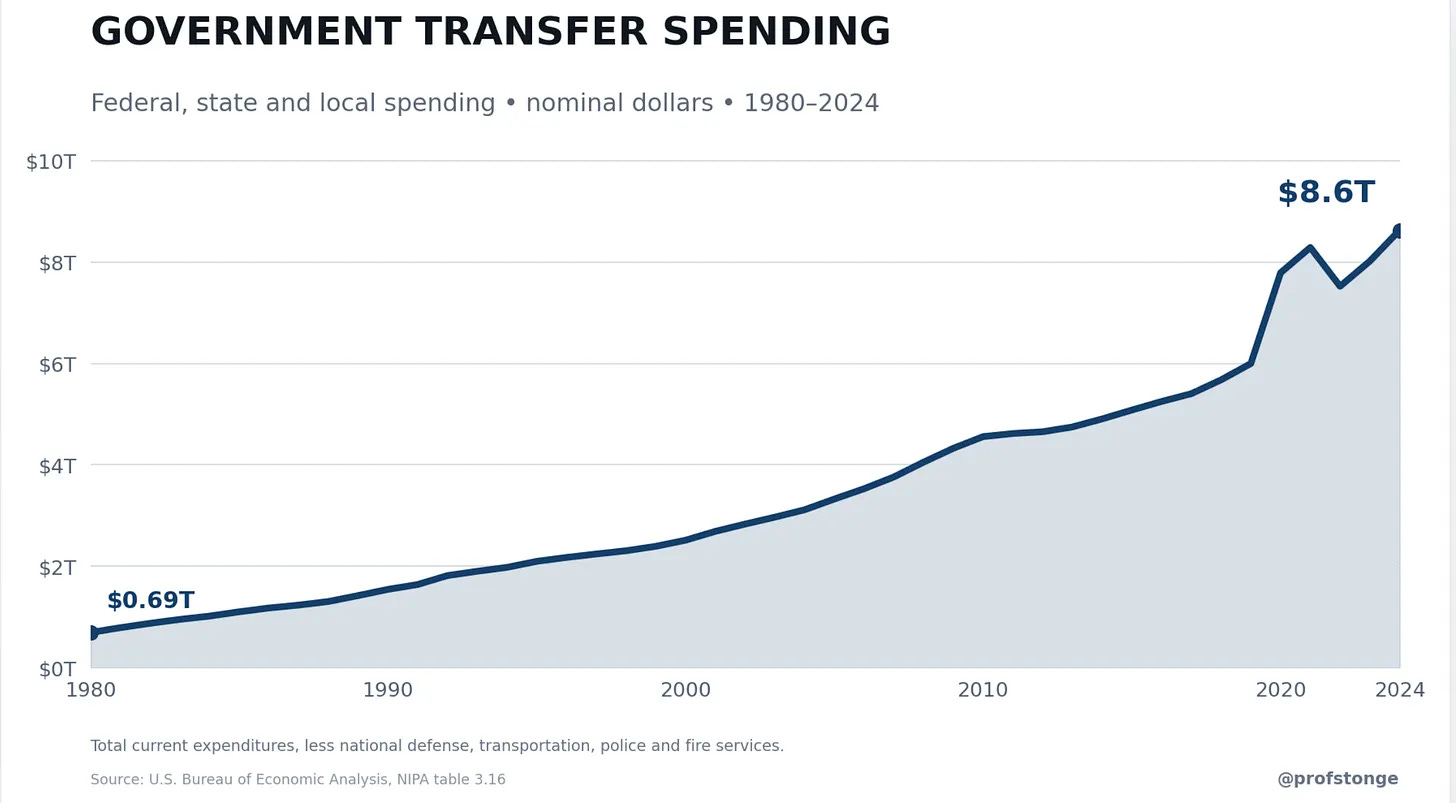
Including welfare, benefits, and pensions, nearly half of all federal, state, and local spending now goes to transferring money from one group of people to another.
That’s roughly six times what America spends on defense. And it comes to nearly $5 trillion a year. Going by recent revelations on fraud rates -- or welfare usage in previous decades -- at least 80% of that is fraud or unnecessary vote-buying.
Implying that the entire deficit is, in fact, waste and fraud.
In other words, America is no longer a limited government with a safety net. It’s a transfer state where the main purpose of your taxes is largely buying votes.

Emergency Deficits Without the Emergency
Federal deficits along are now running 11.1% of GDP, compared with an average of 3.8% in the half centry since Nixon killed the gold standard. Note that half-century included the cold war, multiple recessions, bailouts, wars, and a pandemic.
And here we are tripling it with no emergency on sight.
Interest on the debt alone is approaching $1 trillion per year—roughly as much as national defense. In a few years it will be higher than Social Security, which naturally is now “bankrupt” — meaning even the IOU’s ran out — thanks again to a Congress with no guard rails.
In other words, we’re borrowing the money not for new roads or schools. Not even for social security checks. We’re borrowing it to pay for yesterday’s vote-buying.
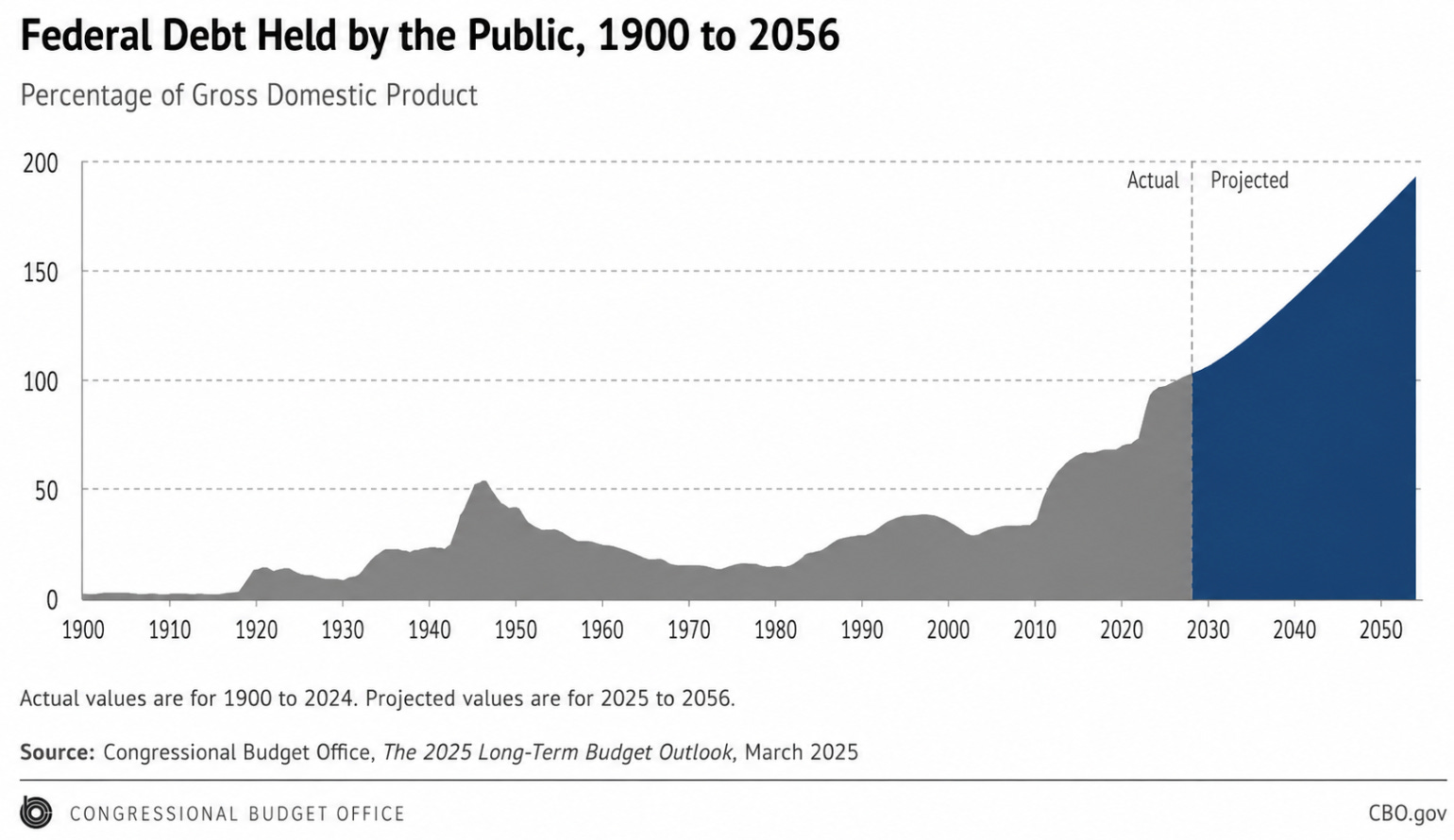
By 2036, the Congressional Budget Office now expects annual interest costs to reach $2.1 trillion. And it expects debt held by the public to surpass the World War 2 peak.
Note that assumes no recession, no major war, no new emergency.
This is vanishingly unlikely given the Federal Reserve now has a 113 year record of delivering recessions like clockwork, thanks to boom-bust manipulation of interest rates that deliver tissue-fire booms followed by wipe-out recessions.
And when the next recession comes, going by history, the deficit will soar by yet more trillions as tax collections collapse and demands for welfare spending soar.

Why Nobody Stops It
This is obviously unsustainable. Yet nobody tries to end it. Elon Musk tried moving heaven and earth, aided by unified control by the “small government” GOP. We had a President who thinks the Federal government is a leech.
And it all bounced off.
Because every transfer program creates a constituency that snowballs pressure for more transfers.
We saw this last year with SNAP cuts, where even Republicans were afraid to couch a program that is overwhelmingly fraud and unnecessary grift.
Because while a program like SNAP matters to regular voters, it’s existential for the tens of millions who take your money.
In other words, the benefits are concentrated and visible: a monthly check, a subsidized premium, or a government-funded service.
But the costs are dispersed among millions of taxpayers—and increasingly pushed onto future taxpayers who cannot vote yet.
That makes the transfer state nearly impossible to reform.
The end result is politicians can survive another trillion dollars of debt. They may not survive trimming a benefit.
So each election brings new promises, outpacing the productive economy squeezed to pay for them.
All while the debt -- and the eventual crash -- compounds against us.

Rome’s Warning
Rome faced the same basic arithmetic: Political promises outrunning production.
The empire maintained an expanding army, a sprawling bureaucracy, public grain distributions, and increasingly expensive efforts to purchase political stability.
But conquest slowed, the tax base weakened, and emperors discovered that cutting promises was dangerous.
Their first move was to buy time with inflation, debasing the currency just as the Fed debases the dollar today.
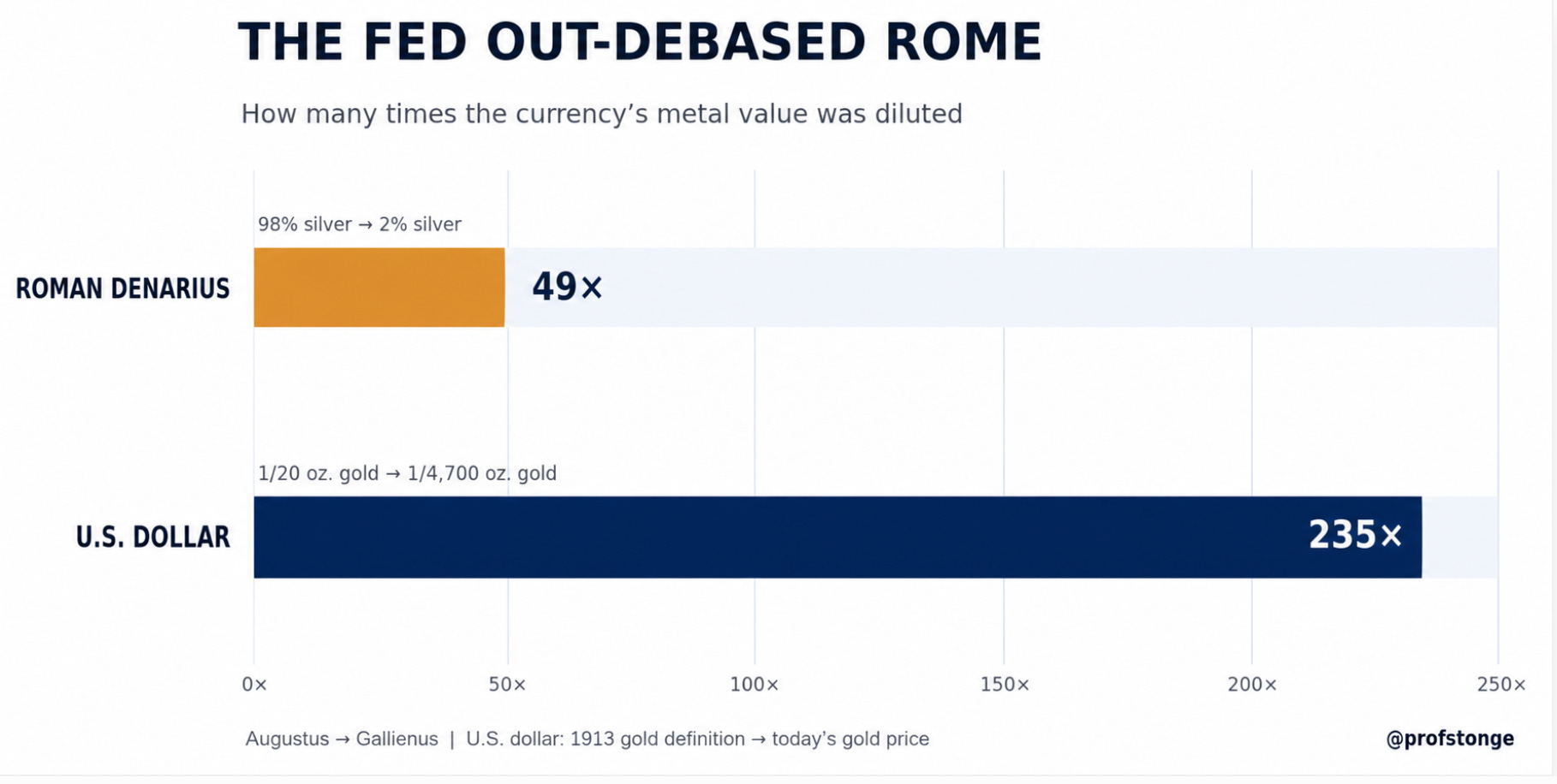
Under Augustus, the Roman denarius was 98% silver. By Gallienus it was 2%.
The Fed’s actually done it faster, sending the dollar from 1/20 ounce of gold to, today, 1/4700. A 99.6% debasement that would put Nero to shame.
What’s Next
For Rome what came next was ugly.
Prices rose by 1,000% in parts of the empire. Good coins disappeared into hoards. Trade shifted toward barter, gold, and payment in kind.
Inflation made contracts unreliable and trade dangerous. Heavy taxes pushed small farmers off their land. Merchants withheld goods rather than accept rapidly depreciating coins.
As commerce shrank, the tax base shrank with it—forcing heavier taxes on what was left and further debasement on whoever remained productive.
Ultimately Rome was too poor to pay off neighboring barbarians. And too corrupt to mount a defense when the time came
The only way America avoids this fate is the one thing Congress will never do: Cut spending.
Enjoyed this article? Get the next one free.
Join 23,000 readers for weekly articles on the economy and freedom, with regular deep dives like the Fall of Rome, the Weimar hyperinflation, and FDR’s Great Depression.
Want to go further? Paid subscribers also get my monthly investment guide including real-money picks that have made 35% annualized returns so far this year on a $100,000 portfolio.
Also, check out my interview with Jim Iuorio, author of The Unfiltered Investor newsletter talking about soaring bond yields and what they mean for the economy and for the accelerating debt crisis.
We cover gold as a lifeboat, whether AI can save this economy — or accelerate the crash. And whether stocks are pricing in the risks or are we headed for a crash.
..."It’s a transfer state where the main purpose of your taxes is largely buying votes."...and so you vote and you get the same garbage over and over but it's just a different color.
Over the last two months, the over-spending has ratcheted up to an annual pace of a $4 trillion deficit. The end of the fiscal year is September 30th and the vote buying is ramping up. True, it's a total waste of money like wars and golden ballrooms.
While all of this is true, and I greatly appreciate the content let’s be fair as I don’t see any mention or criticism in your article of Donald J Trump, who is the most responsible person for these deficits. Starting from the money he printed during Covid to this unnecessary war with Iran. It’s the forever wars, not just the Social Security that is the problem so let’s be fair and honest here.