


Last week, the Federal Reserve raised interest rates for the first time in three years. Apparently the housing market wasn’t dead enough.
The quarter-point increase took the Fed’s benchmark to nearly 4%, more than double the 1.8% average since the year 2000.
With another 2 hikes predicted by next April.
More important, it sent mortgage rates to 7.12% — which higher than 96% of month since 2000.
For Americans waiting for cheaper mortgages after Bidenflation, the light at the end of the tunnel turned into a train.

The Covid Lock-In
The problem is millions of Americans are locked in to cheap mortgages they signed during Covid, when the Fed yanked rates to near-zero to bribe voters into lockdowns.
Those cheap rates set off the worst inflation since the 1970’s. And they mean today nearly half of mortgages are currently under 4%. One in five is under 3%.
In other words, for half of Americans, moving into the exact same house nearly doubles their mortgage rate. For the median home, a $980 mortgage payment now would cost $2,312 per month.
The difference being nearly $16,000 per year. In case Congressthings wonder why young people are voting Socialist.
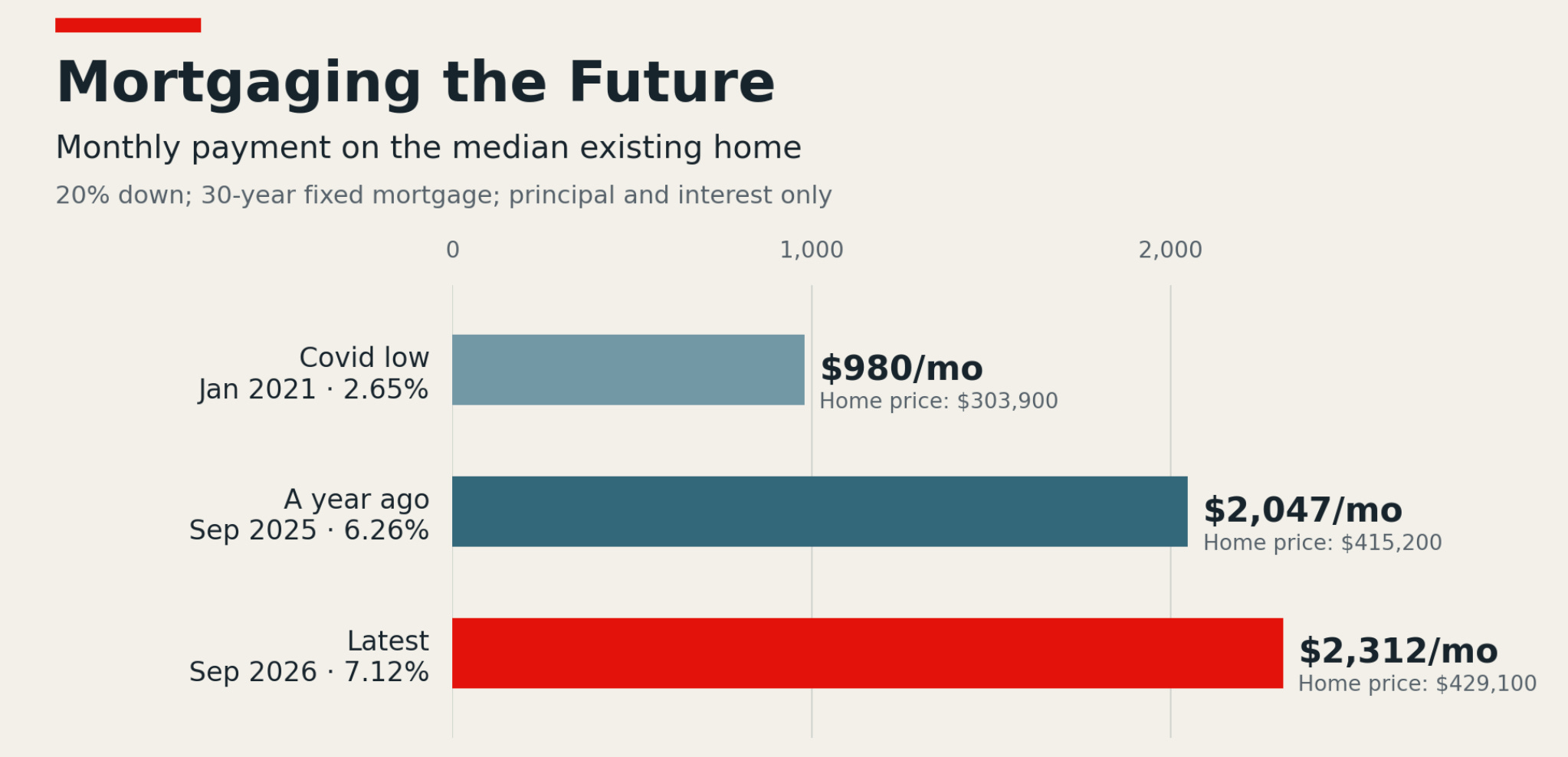
And it keeps getting worse: In the last year alone, a mortgage on the median home is up $265 per month.
Projected hikes could take the median mortgage close to 8% -- spitting distance to $3,000 per month. For the median.
For almost 5 years now, this lock-in has been freezing the housing market, taking it down more than half since the October 2020 peak.
Part of that is higher rates, but the Federal Housing Finance Agency estimates lock-in prevents nearly a million sales per year.

On the ground, that looks like empty-nesters hogging big houses even after the kids move out -- they can’t afford to move.
While young families are forced to rent since a 7.12% mortgage would require $117,000 in annual income to qualify -- a tall order for twenty-somethings.
Renting means they don’t even start building a nest egg until they’re middle aged.
The National Association of Realtors estimate the age of a first-time home-buyer is now 40, up 7 years in just 5 years. And up from 29 in 1981, when we had a functioning housing market.

What’s Next
The Fed could fix housing tomorrow by cutting rates. And they were poised to before wartime oil prices, which took inflation from under 2% to annualized 5% since the war began.
So with rate cuts off the table, with deficits driving up mortgages even beyond hikes, and with little effort from Congress to meaningfully cut permitting and regulatory barriers the NAHB says add $131,000 to the price of a home, housing will keep getting worse for young Americans who feel like they’re running on a treadmill living on crumbs.
And are willing to vote for any Democrat Socialist who promises a miracle.
Enjoyed this article? Get the next one free.
Join 23,000 readers for weekly articles on the economy and freedom, with regular deep dives like the Fall of Rome, the Weimar hyperinflation, and FDR’s Great Depression.
Want to go further? Paid subscribers also get my monthly investment guide including real-money picks that have made 41% annualized returns so far this year on a $100,000 portfolio.
Also check out my weekly interview series. This week I’m joined by economic historian Patrick Newman of the University of Tampa and Rothbard Fellow at the Ludwig von Mises Institute.
We talk about the rise of crony capitalism, why DOGE and the GOP Congress didn’t make a dent, and how it drives young voters into the arms of Socialism.
Then we walk through potential solutions, and whether they can happen before a debt crisis hits.
Things are hard right now, but we are going into the Fourth Turning as described by William Strauss and Neil Howe in their book of the same name. We will emerge even better, we just have to carry on best we can. Many other generations have done it.
I agree. I am still voting republican. Unfortunately DC/ Senate and the House
does not like President Trump or we the people. They are trying to destroy him and. his presidency. Unfortunately.
I was really upset they raised rates into an oil crises.