

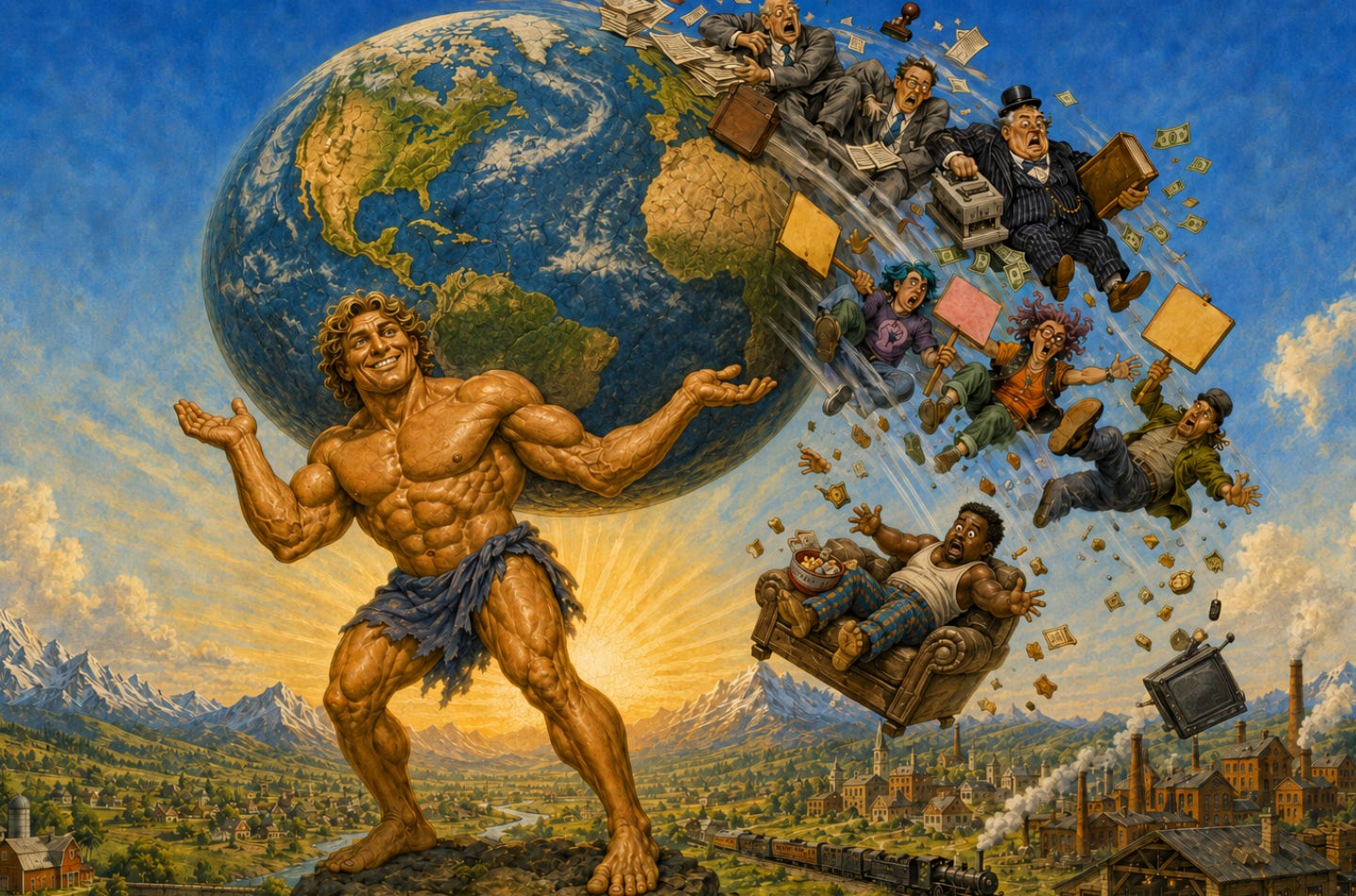
Could America Grow at 20%?
President Trump was in the Oval Office this week explaining why the Federal Reserve should stop strangling the economy when he dropped a vintage Trump number:
“We could have a GDP of 14, 15, 16 and 20” percent growth. If only the Fed got out of the way.
By which he means the Fed printing money with low rates.
Trump’s 20% is definitely a stretch goal; the Congressional Budget Office is currently projecting long-term growth of just 1.8%. Ten times less.
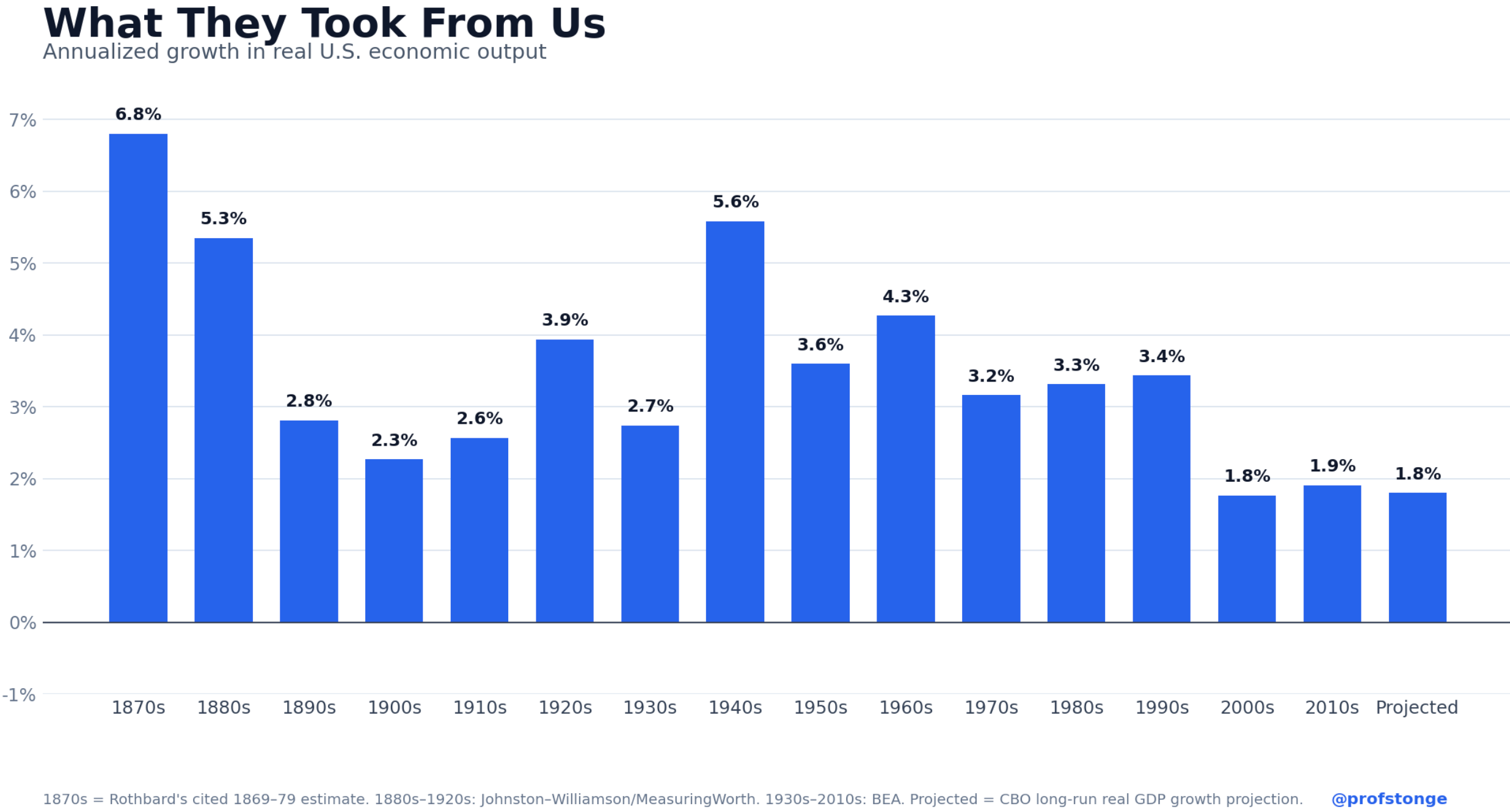
In fact, since quarterly GDP records began in 1947, America has exceeded 20% only once: the artificial 34.9% Covid reopening bounce in 2020.
But the broader point—that America could grow dramatically faster -- is absolutely correct. In fact, there was a time when America enjoyed durable 7% growth. At that rate, real wages grow roughly sixfold in a generation.
Unfortunately, that was the 1870s. Meaning we would have to End the Fed -- End it, not money-print a fake boom. We’d also have to End the Income Tax and DOGE the entire administrative state built by cronies in the Progressive Era through the New Deal to straitjacket the economy into, apparently, 1.8% growth.
So, practically speaking, it’s probably easier to invent cold fusion.

America’s Forgotten Boom
In his epic History of Money and Banking, Austrian-school economist Murray Rothbard highlighted the extraordinary period from 1869 to 1879 — the very decade mainstream textbooks traditionally call the “Long Depression.”
Using estimates from Milton Friedman and Anna Schwartz, real national product grew 6.8% per year, while prices actually fell by nearly 4% a year.
In other words, the economy nearly doubled while everything got cheaper. So it was prices that depressed, living standards soared.
Unfortunately, the Fed would never allow this today -- it lives to fight deflation, which it erroneously blames for the 1929 Great Depression and which pleases the Wall Street banks who bribed the Fed into being.
Today’s Fed would print $8 trillion to rescue us from affordable groceries.
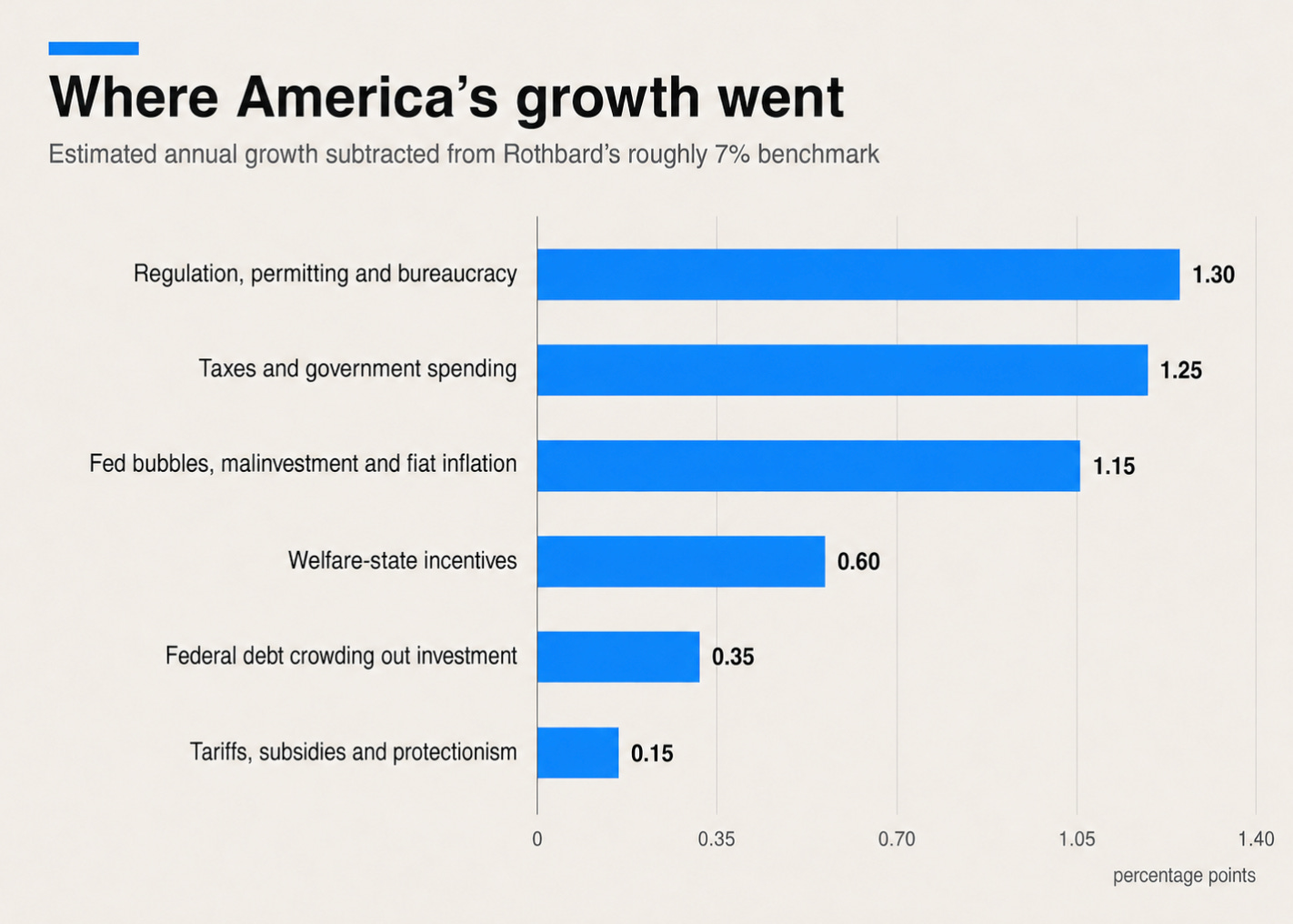
So where did the growth go? How did we go from a 7% economy to a 2% economy.

Where the Growth Went
Start with government spending, which knocks off roughly 1.25%. Federal, state and local spending approaches nearly half of everything we produce -- a parasite dangerously close to taking over the host.
That capital goes where lobbyists want it, where it buys the most votes, and a good chunk goes to employing regulators and bureaucrats who dream up new ways to harass entrepreneurs and producers on top of the taxes they take.
Next is regulation. The federal rulebook contains roughly 190,000 pages filling 244 bound volumes. State codes can double this: New York state’s regulatory code runs to 18 million words and 300,000 restrictions. Ohio is 22.6 million words.
Counties can add thousands more restrictions: Los Angeles County publishes an 8-volume set of restrictions. Then cities pile on yet another layer: New York City has over 10,000 pages of mandates and restrictions spanning 21 volumes.
This mountain of rules cripples entrepreneurs. It sends jobs overseas where China winks and nods away rulebooks. It crushes or delayed for decades housing, factories, mines, pipelines, power plants and transmission lines.
Next is the Fed, who drains growth by manipulating interest rates -- or even direct money-printing, called QE. Cheap money sparks artificial “tissue fire” booms followed by busts and bailouts. Each time the economy moves 2 steps forward, it goes 1 step back in a recession, and you pay the inflation.
Then the welfare state, which literally pays millions of able-bodied people not to work, consuming now half of all government spending to, ultimately, buy votes to install socialism on what’s left.
We lose those millions of workers -- or have to import replacements from the third world. And their bought votes feed Leviathan year by year.
Toss in the $40 trillion debt crowding out productive investment. The crony corporate subsidies and tariffs that, unlike Trump’s tariffs for negotiating leverage, live forever as corporate handouts, and it’s a wonder we even manage 1.8% growth.

What’s Next
Trump is right that America can grow much faster -- probably 4 times faster. Enough that the next generation could be looking at six-figure starting salaries. And their kids would be looking at $250,000 out of high school.
But the way to do it isn’t flooding easy money from the Fed. It’s systematically deconstructing the leviathan government crushing the productive economy.
Unfortunately, Ending the Fed, Ending the Income Tax, and Ending the Administrative State means going up against the entire lobbying industrial complex armed with, of course, tax dollars they steal from you.
Meaning that it won’t happen unless we get a crisis that concentrates voters’ minds enough that, like Argentina and Milei, Americans are ready for radical change.
Enjoyed this article? Get the next one free.
Join 23,000 readers for weekly articles on the economy and freedom, with regular deep dives like the Fall of Rome, the Weimar hyperinflation, and FDR’s Great Depression.
Want to go further? Paid subscribers also get my monthly investment guide including real-money picks that have made 41% annualized returns so far this year on a $100,000 portfolio.
And check out my interview series. This week I sat down with economist Daniel Lacalle to discuss Europe's migrant crisis and its coming economic and political crisis.
We dig into the migrant invasion of Ceuta, whether Europe can preserve open internal borders while losing control of its external ones, and the vicious cycle linking the welfare state, collapsing birth rates, mass immigration, and still more government.
We also examine why Europe has fallen so far behind America in productivity, technology, and living standards; what to fix first if Brussels handed him Milei’s chainsaw; and whether Javier Milei’s dramatic turnaround in Argentina offers Europe a path back -- or a warning Europe will ignore until it goes over the cliff.
See you next week!
Trump is not anchored in reality. He starts a war with Iran for Israel with the tab still running and acts like it simply doesn't matter. Also, let's face it; America makes precious little. We are down to one American plant which still makes denim cloth after the other closed a couple of years ago. So while we can still buy American-made jeans, how much longer will this last? Even what we do make we typically use a number of imported goods in the process. We are the Emperor with no clothes and one day, probably sooner than later, the Bond Market is going to call our bluff.
As you say, getting back to 1870s thinking would be a great start. If we stopped escalating the salaries of those who impair productivity and instead stopped penalizing those who strive to direct their own effort productively, prosperity would be around the corner. If we truly saw the government as the criminal element they have become, public outrage would put an end to it.
Thinking back to the words of Frederic Bastiat, the world has done everything possible to ignore and avoid the correct path.