


The economy is booming. But nobody’s hiring.
Is creating jobs a lost art from a far-gone age?
Last week the Atlanta Fed put third-quarter growth at a sizzling 3 and a half percent. Yet September added just 29,000 jobs -- basically flat in an economy of 163 million jobs.
Traders on kalshi forecast an almost as bad 70,000 this month -- less than population growth. In a sizzling economy.
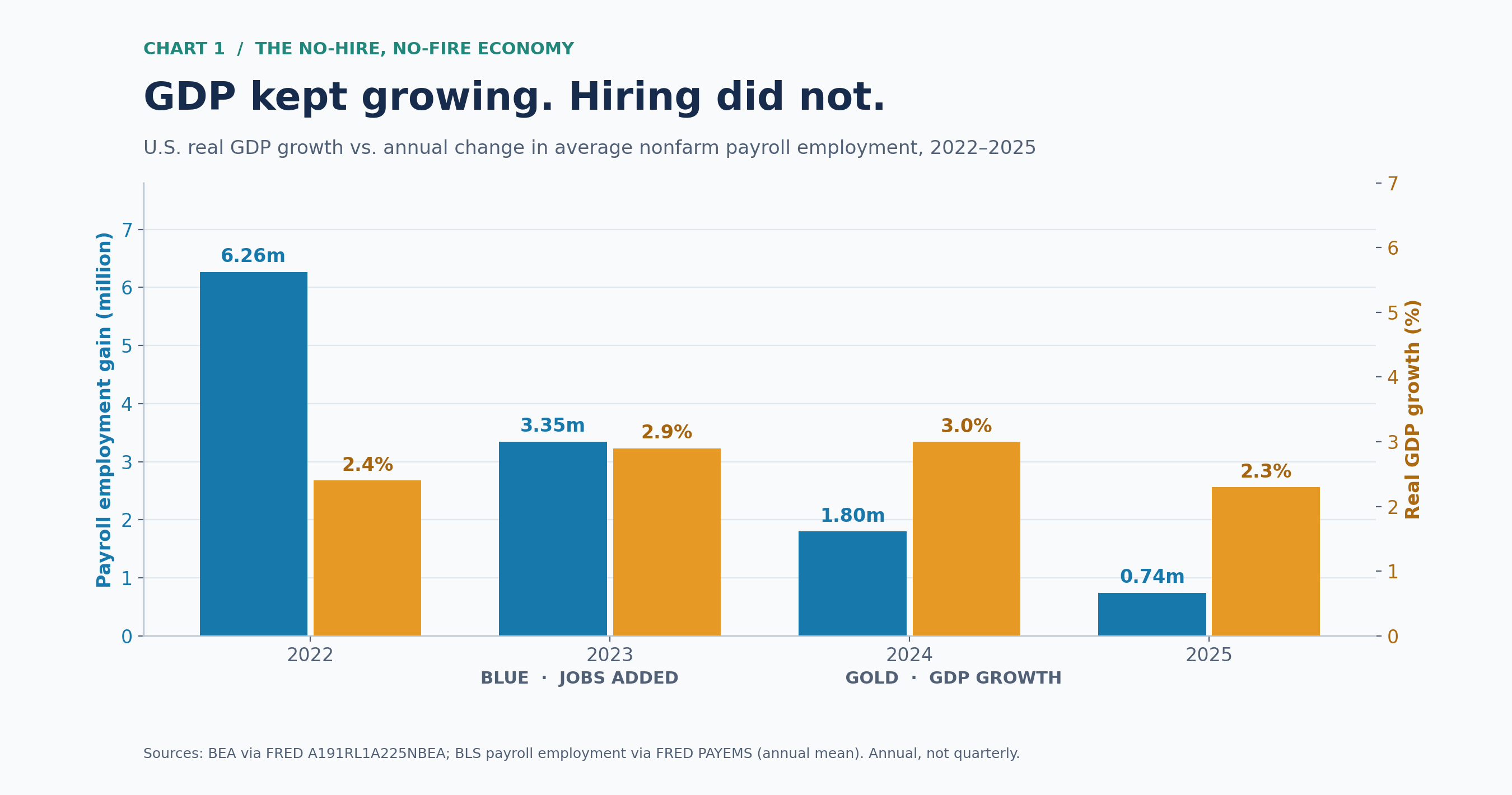
The puzzle is unemployment is actually low at 4.2%, where it’s been for pretty much a year and a half. Jobless claims are actually near historic lows.
In other words, companies aren’t firing workers. They’re just not hiring new ones.
This is odd -- usually booming GDP spawns jobs like mushrooms after rain.
And the reason could be Artificial Intelligence -- superintelligence if you didn’t get the memo.
The idea being that AI isn’t crushing jobs by the millions, but it is encouraging companies to do more with the people they’ve got. Meaning they’re delaying new hires.

College Grads Take it on the Chin
The first casualties are recent college grads, especially those destined for America’s cubicle farms.
An August Stanford study found that employment among 22-to-25-year-olds in AI-exposed occupations was almost 20% below low-exposed jobs.
With the gap growing by a third in the last year, from 15% fewer hires to 20% fewer.
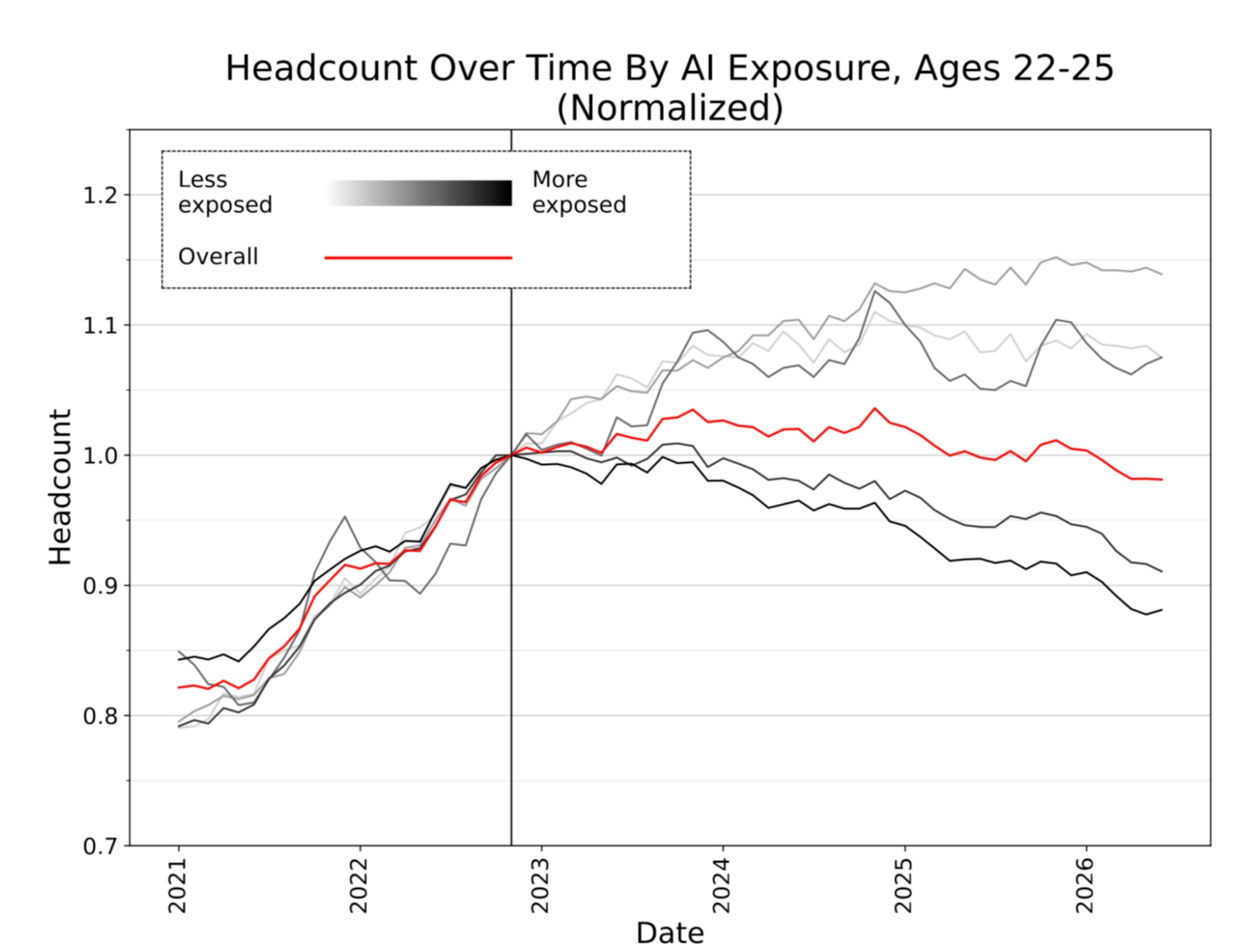
Interestingly, experienced workers have no gap -- just the new hires.
So junior programmers, administrative assistants, entry-level analysts, the army of recent graduates whose job was to rearrange PowerPoint to entertain middle-managers.
This is creating an interesting labor market: experienced workers are valuable because they’re actually more efficient with AI.
But New graduates can’t get the experience because AI replaced them before they even showed up.
So AI’s not taking all the jobs, but it is taking the first rung of the career ladder.

Is This Time Different?
We’ve seen this movie before.
In 1900, half of American workers worked in agriculture. Along came tractors and combines and today it’s less than 2%.
Yet America didn’t end up with 38% unemployment. Because workers were freed to make cars, airplanes, write software, and teach yoga.
It happened again when computers eliminated typists, bookkeepers, and clerks. Creating millions of jobs in software, telecommunications, online commerce and fulfillment centers.
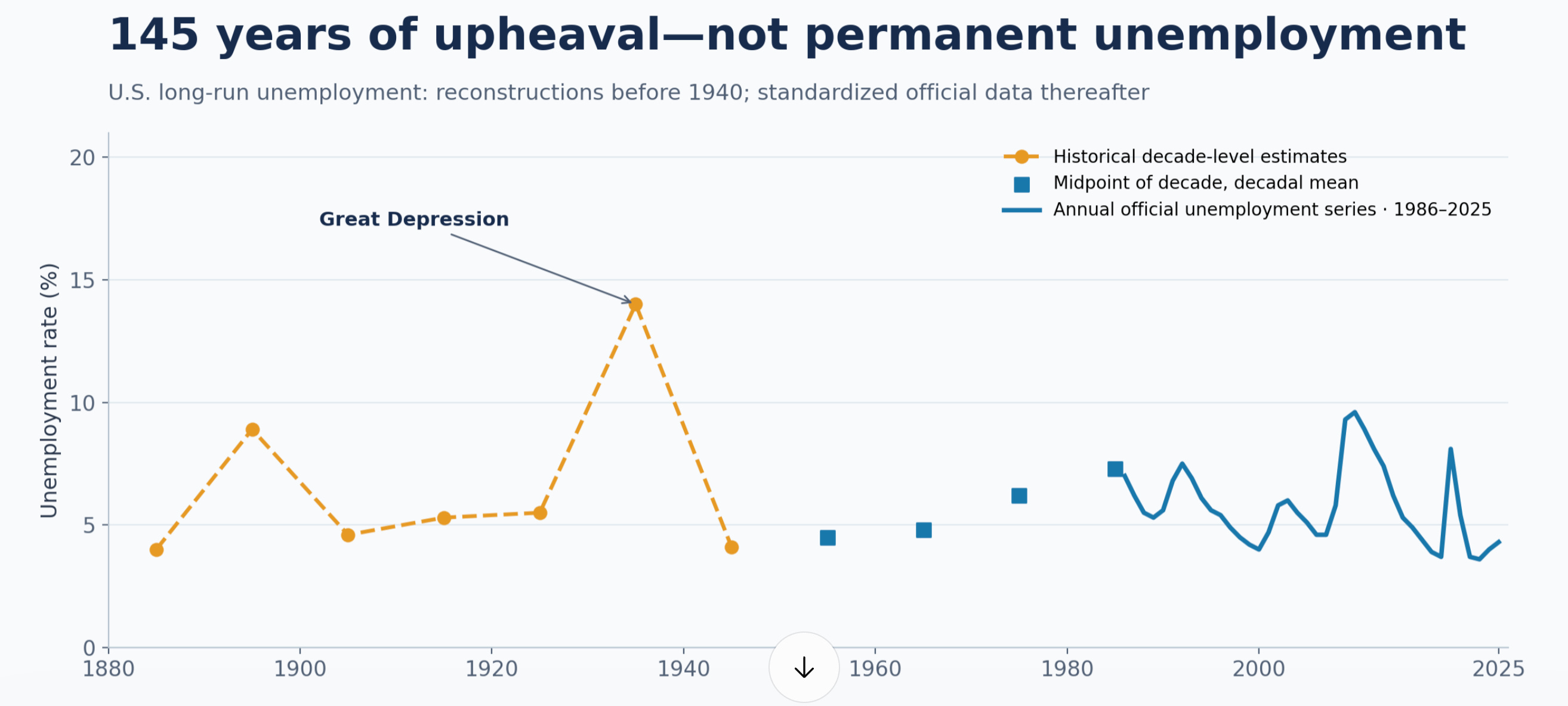
Because technology doesn’t simply eliminate work. It makes workers more productive, lowers production costs, increases purchasing power -- customers buy more stuff, especially services: Great news for yoga instructors.
The catch is those new jobs don’t appear automatically. Entrepreneurs have to create them. And that’s where governments enter the story.
Starting a business -- or hiring your first employee -- can mean licenses, zoning, permits, tax registrations, insurance mandates, payroll compliance, labor-law restrictions. An obstacle course trying to crush the next wave of jobs.
These matter most to small companies, precisely where the next generation of jobs should come.
New business establishments already create roughly 4 million jobs a year. But imagine how much faster if starting a business -- or hiring an employee -- was like ordering a t-shirt on Amazon.

What’s Next
The solution isn’t to ban technology any more than banning tractors or electricity. It’s to unleash tomorrow’s entrepreneurs.
Slash occupational licensing, payroll taxes, employment-law complexity. Strip away unnecessary permits and zoning. Make it easy to start a business, experiment, and hire the first employee.
Technology has been eliminating jobs for thousands of years. In fact, that’s how we became rich, the industrial revolution wiping out farm laborers.
But what we didn’t have in 1840 was an empire of tax and regulation roadblocking millions of new jobs.
If that doesn’t change, this time will be different.
Enjoyed this article? Get the next one free.
Join 23,000 readers who get my weekly take on the economy, markets, and freedom, in plain English with no spin.
Plus regular deep dives like the Fall of Rome and the Weimar hyperinflation.
Want to invest alongside me?
My paid subscribers get my monthly investment guide, with the actual stocks I’m buying and shorting.
So far this year my $100,000 model portfolio has returned 51% annualized.
For just $8 a month, get my latest picks, market analysis, and monthly updates.
Or take a peek at what you’re missing in my latest investment guide:

See you next week!
Looks like an opportunity for employee leasing companies.
"The economy is booming. But nobody’s hiring."? Really?
Most of the GDP growth was from AI Capex and inventory build (due to weak consumer sales. So perhaps the answer lies in false assumptions.